
A freeze dryer—also called a lyophilizer—removes moisture from a product that has first been frozen. Inside the machine, pressure is reduced so that ice can leave the product mainly as vapor rather than melting back into liquid. The vapor is captured on a cold condenser while controlled heat supports the drying process.
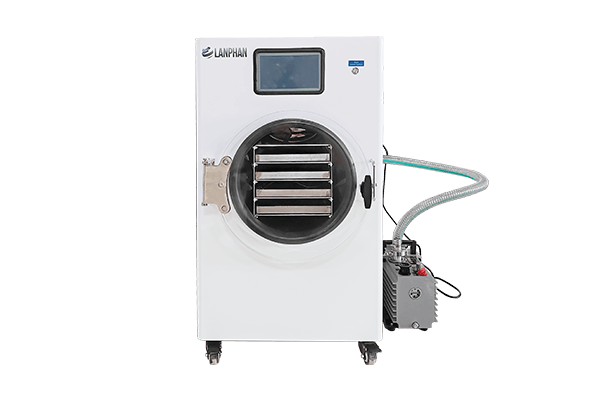
What Does a Freeze Dryer Do?
The machine creates and controls the conditions needed for freeze drying. It freezes or receives a frozen load, reduces chamber pressure, supplies controlled energy to the product and captures the released vapor. The goal is not simply to make something dry. The process must also protect the product attributes that matter for its later use.
Those attributes may include structure, reconstitution, appearance, residual moisture, stability or another application-specific requirement. A freeze dryer cannot guarantee any of these outcomes from chamber size or condenser temperature alone. Formulation, loading, cycle development and packaging also affect the result.
How Freeze Drying Works
1. Freezing
The product is frozen before primary drying. Freezing conditions influence the ice structure and the pathways through which vapor later leaves the material. Some freeze dryers use controlled shelves for freezing; other workflows use separate pre-freezing equipment.
2. Primary Drying
Chamber pressure is reduced and energy is supplied in a controlled way. Ice sublimes and the vapor moves toward the colder condenser. The product temperature must remain within a suitable range for the formulation and structure. Increasing heat without understanding the product can cause collapse, melting or other damage.
3. Secondary Drying
After most visible ice has been removed, moisture can remain associated with the product. Secondary drying uses controlled pressure and temperature to reduce this residual moisture. The endpoint depends on the material, its packaging and its intended use; it should not be copied from an unrelated product.
Main Parts of a Freeze Dryer
| Component | Function | What the buyer should confirm |
|---|---|---|
| Drying chamber | Holds trays, vials, flasks or another load format | Usable loading area, container format, access and cleaning |
| Condenser | Captures vapor released from the product | Expected moisture load, defrost, drainage and solvent compatibility |
| Vacuum system | Creates and maintains reduced pressure | Pump type, protection, exhaust and maintenance requirements |
| Refrigeration and shelves | Cool the condenser and, in shelf systems, control product temperature | Shelf control, utilities, ambient limits and heat rejection |
| Controls and sensors | Monitor cycle conditions, alarms and recipes | Required data, access control, records and validation functions |
Types of Freeze Dryers
Home freeze dryers
These systems are generally selected for food batches and household workflows. Buyers should consider preparation, tray capacity, room ventilation, heat release, noise, drainage, vacuum-pump care and packaging—not only the number of trays.
Laboratory freeze dryers
Laboratory systems may use manifolds, chambers, trays or controlled shelves. The correct format depends on the sample, container, moisture load and whether the purpose is basic drying or process development.
Pilot and production freeze dryers
Scale-up requires more than a larger chamber. Loading pattern, shelf area, condenser demand, cycle transfer, utilities, cleaning, records, maintenance access and production scheduling must be considered together.
What Materials Are Freeze Dried?
Freeze drying is used for selected foods and ingredients, laboratory samples, biological materials, formulations and specialty materials where the required result justifies the process. The application name alone does not establish suitability. Two products from the same industry can behave differently because their composition, freezing behavior and structure are different.
Products high in oil, fat, sugar or solvent may require special evaluation or may not suit a standard system. Organic-solvent applications require written confirmation of materials compatibility, recovery, vacuum-pump protection and site safety. Do not treat a standard water-based configuration as solvent-ready.
Freeze Dryer vs Freezer vs Dehydrator
- Freezer: lowers the product temperature but does not remove the moisture required to create a dry product.
- Dehydrator: removes moisture mainly through heated moving air and evaporation.
- Freeze dryer: works with a frozen product under vacuum and removes ice mainly through sublimation.
The methods produce different structures and require different equipment, cycles and packaging. None is automatically best for every product. See the detailed freeze dryer vs dehydrator comparison when choosing a food-preservation route.
What Determines Freeze-Drying Time and Capacity?
There is no reliable universal cycle time or “output per day” for all materials. Product composition, starting moisture, fill depth, container, loading pattern, freezing method, product-temperature limit, condenser load, vacuum performance, defrost and cleaning all affect practical throughput.
Nominal chamber volume is not usable product capacity. A meaningful quotation should state the assumed material, load per batch, loading format and cycle basis. Unknown formulations should be tested before production performance is promised.
Food Safety and Shelf-Life Limits
For food applications, freeze drying is not a kill step for illness-causing microorganisms. Safe handling, cooking, sanitation and packaging requirements still apply. The University of Minnesota Extension notes that microorganisms can survive the process and become active again after moisture is added.
A freeze dryer also does not guarantee a fixed shelf life. Residual moisture, package barrier, seal integrity, oxygen, storage temperature, light, food composition and handling all matter. Commercial shelf-life claims should not be copied to an untested home or industrial product.
Information to Prepare Before Requesting a Quote
- Material name, formulation and solvent system.
- Starting moisture or solids content.
- Load per batch and intended batches per day or week.
- Tray, vial, flask, bottle or bulk loading format.
- Required final moisture, structure, reconstitution or stability target.
- Current project stage: research, pilot or production.
- Available utilities, voltage, cooling, drainage and installation space.
- Cleaning, records, alarm, recipe or validation requirements.
Frequently Asked Questions
Is a vacuum required for freeze drying?
Yes. Reduced pressure is a core part of the process because it supports sublimation and vapor movement from the frozen product to the condenser.
Can a regular freezer freeze dry food?
No. A freezer can freeze food, but it does not provide the controlled vacuum, vapor capture and drying stages of a freeze dryer.
Does a colder condenser always mean faster drying?
No. Condenser temperature is only one part of the system. Product resistance, shelf conditions, chamber pressure, vapor load and equipment design also affect the process.
Where should a buyer compare equipment types?
Use the Freeze Dryer Buyer Guide for detailed selection factors, or review the Lanphan freeze dryer range when the application and batch requirements are ready.
 English
  Russian
  Arabic
  Spanish