
Freeze drying and dehydration both remove moisture, but they do not produce the same material. A freeze dryer removes ice under vacuum after the product has been frozen. A dehydrator uses warm moving air to evaporate water. The right choice depends on the product, the required texture and rehydration, storage conditions, batch size, utilities and operating budget.
This guide is written for buyers comparing equipment for food development, laboratories, pilot production and commercial processing. It focuses on process differences and purchasing questions rather than unsupported shelf-life promises.
Freeze Dryer vs Dehydrator at a Glance
| Decision factor | Freeze dryer | Dehydrator |
|---|---|---|
| Moisture-removal method | Freezing followed by sublimation under vacuum | Evaporation with heated, moving air |
| Typical finished structure | Porous and lightweight, with limited shrinkage when the cycle is suitable | Denser and often chewier, with more visible shrinkage |
| Rehydration | Usually faster because the dried structure remains porous | Usually slower and may not restore the original structure |
| Process temperature | Low product temperature during primary drying | Moderate or warm air, depending on the material |
| Equipment complexity | Requires refrigeration, vacuum control and a condenser | Uses heaters, fans and airflow control |
| Cycle and operating demands | Longer cycles and closer process control | Simpler operation and generally shorter cycles |
| Best fit | Products where structure, rehydration or heat sensitivity matters | Products suited to warm-air drying and a simpler process |
How Freeze Drying Works
Freeze drying, also called lyophilization, begins by freezing the product. The chamber pressure is then reduced so that ice can change directly into vapor during primary drying. A later secondary-drying stage removes additional bound moisture. The condenser captures vapor before it reaches the vacuum system.
The result depends on more than the machine name. Product formulation, fill depth, freezing conditions, shelf temperature, chamber pressure and endpoint criteria all influence the cycle. Buyers should therefore compare control capability and usable shelf area, not only chamber volume.
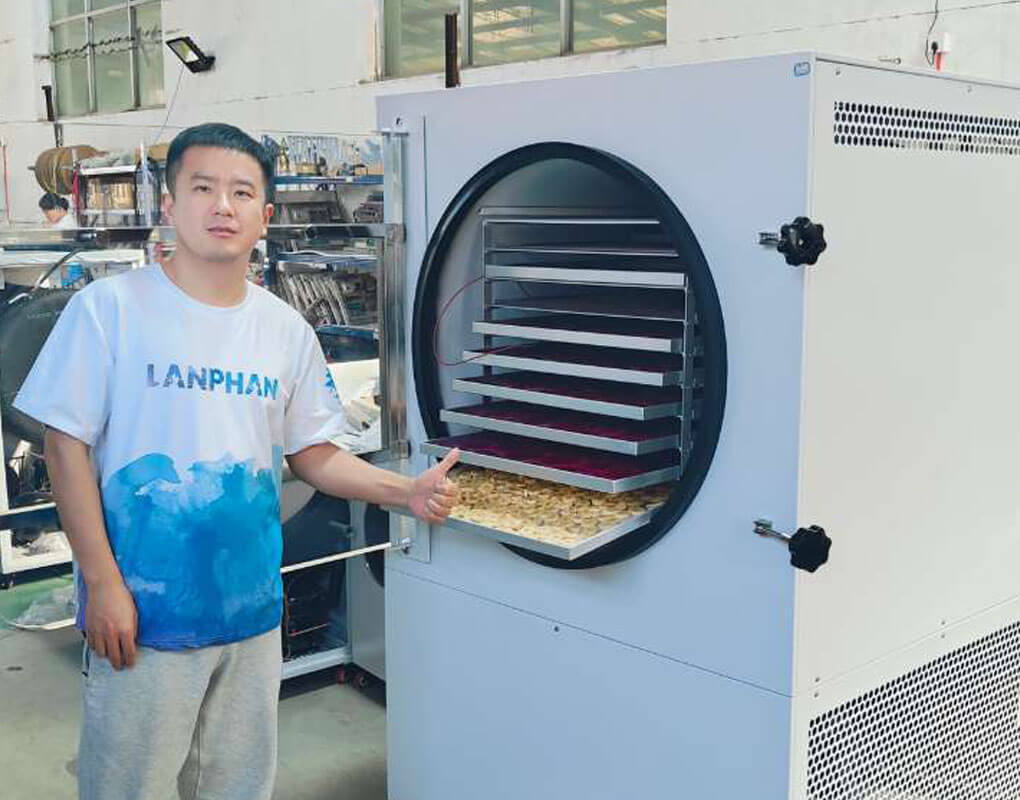
For equipment configurations and scale options, see the Lanphan freeze dryer range. Buyers developing recipes or small batches can also review the home and small-batch freeze dryer options.
How Dehydration Works
A dehydrator passes heated air across the product. Water evaporates from the surface, while moisture inside the material moves outward. Temperature, airflow, loading density, piece size and tray arrangement affect uniformity and drying time.
This process is mechanically simpler than freeze drying and can be appropriate for herbs, sliced fruit, vegetables, jerky-style products and other materials that tolerate warm-air drying. It can also be easier to maintain because it does not require a refrigeration circuit or vacuum system.

How the Finished Products Differ
Structure and appearance
Freeze drying can retain more of the product’s original shape because water leaves the frozen structure as vapor. Warm-air dehydration normally causes greater shrinkage as cell structures soften and moisture migrates. The acceptable result depends on the product specification; a compact, chewy texture may be desirable for one application and unacceptable for another.
Rehydration
The porous structure created by a suitable freeze-drying cycle generally allows water to return more quickly. Dehydrated products often rehydrate more slowly and may remain denser. Buyers developing instant foods, ingredients or laboratory samples should test rehydration against a defined method rather than relying on visual appearance alone.
Heat-sensitive characteristics
Freeze drying limits exposure to warm air, which can be useful for heat-sensitive materials. It does not guarantee that every nutrient, aroma or active component will remain unchanged. Raw material condition, pretreatment, oxygen exposure, cycle design and packaging all matter. Dehydration can also produce a good result when the chosen temperature and residence time fit the material.
Final moisture and storage stability
Neither process creates a reliable storage life by itself. Final moisture, water activity, oxygen and moisture barriers, sealing quality and storage temperature must be considered together. Ask suppliers to explain how moisture endpoints are measured and plan product-specific stability testing before making commercial claims.
Which Process Fits Your Application?
Choose freeze drying when
- The product is heat-sensitive or must retain a porous structure.
- Fast or consistent rehydration is an important quality requirement.
- The material has enough value to justify longer cycles and more complex equipment.
- The process requires repeatable shelf-temperature and vacuum control.
- You can support refrigeration, vacuum, defrosting and cleaning requirements.
Choose warm-air dehydration when
- The product tolerates the selected drying temperature.
- A denser or chewy finished texture is acceptable or preferred.
- Simplicity, throughput and operating cost are more important than rapid rehydration.
- The facility needs equipment that is straightforward to operate and maintain.
- Trials confirm that airflow and tray loading produce acceptable uniformity.
Some processors use both methods for different product groups. The correct comparison is not “which technology is better?” but “which process produces the required specification at an acceptable total cost?”
Buyer Checklist: What to Compare Before Requesting a Quote
1. Product and formulation
Provide the product type, starting moisture, solids content, oil or sugar level, solvent content if applicable, and any heat-sensitive characteristics. A supplier cannot recommend a credible configuration from batch weight alone.
2. Batch size and loading format
State batch mass, tray loading depth, container type and expected batches per day. For freeze dryers, usable shelf area is often more useful than an empty chamber-volume figure. For dehydrators, tray area, airflow path and loading density are central.
3. Required endpoint
Define how success will be judged: final moisture, water activity, rehydration time, appearance, potency, texture or another measurable requirement. If the endpoint is not yet known, plan pilot trials before buying production-scale equipment.
4. Utilities and installation
Confirm electrical supply, cooling-water or air requirements, room temperature, ventilation, drainage, available floor space and access for installation. Freeze dryers also need a suitable vacuum system and condenser capacity; dehydrators need stable airflow and heat rejection.
5. Cleaning and material contact
Ask which surfaces contact the product, how trays and chambers are cleaned, whether drainage is practical and what access is available for inspection. Sanitary expectations differ between food, laboratory and pharmaceutical environments, so the intended use must be stated clearly.
6. Controls and documentation
Compare recipe control, data recording, alarms, sensor access and service documentation. Do not assume that a touchscreen automatically provides the records or control functions required by your quality system.
7. Total operating cost
Consider cycle time, power demand, labor, maintenance, consumables, packaging and expected product value. Freeze drying usually requires a higher investment and more process support; dehydration may be more economical when warm-air drying meets the specification.
Common Purchasing Mistakes
- Comparing only chamber volume. Product capacity depends on shelf or tray area, loading depth, moisture load and cycle conditions.
- Accepting a universal capacity claim. The same machine can process very different batch weights for different materials.
- Skipping product trials. A trial helps expose collapse, uneven drying, overheating, poor rehydration or unacceptable cycle time before scale-up.
- Ignoring packaging. A well-dried product can still absorb moisture or oxidize after processing.
- Buying without a service plan. Ask about installation support, spare parts, vacuum-pump maintenance, refrigeration service and troubleshooting responsibility.
Questions to Send an Equipment Supplier
- Which model is recommended for our actual tray load and product depth?
- What information is needed to estimate cycle time?
- Can the proposed system record shelf temperature, product temperature and chamber pressure?
- How is defrosting handled, and how long does turnaround take?
- Which utilities and room conditions are required?
- Which parts need routine replacement, and which spares should be kept on site?
- Can a product trial be performed before final configuration?
Frequently Asked Questions
Is a freeze dryer the same as a dehydrator?
No. A freeze dryer removes frozen water under vacuum, while a dehydrator evaporates water with heated airflow. The processes create different structures, utility requirements and operating costs.
Which method gives a longer shelf life?
Shelf life cannot be assigned from the drying method alone. Final moisture, water activity, product composition, packaging, oxygen exposure and storage conditions must be validated for the specific product.
Can a dehydrator replace a freeze dryer?
Only when warm-air drying still meets the required product specification. It is not a direct substitute when porous structure, rapid rehydration or low-temperature processing is essential.
Can I estimate freeze-dryer capacity from chamber size?
Not reliably. Use shelf area, tray loading, product depth, starting moisture, condenser capacity and validated cycle time to estimate practical throughput.
Should I run a pilot test before purchasing?
Yes, especially for a new formulation or scale-up project. Pilot testing provides evidence for loading, endpoint, cycle time and finished-product quality.
Next Step
Prepare a short process brief with product description, batch size, loading format, required endpoint, available utilities and target production schedule. Lanphan can then compare suitable freeze dryer configurations without relying on generic capacity claims.
 English
  Russian
  Arabic
  Spanish