
A lab-scale spray dryer is most useful when a team needs process evidence before committing more material, time or budget. It can turn a prepared liquid feed into a powder sample, but its larger value is diagnostic: the trial shows how the feed atomizes, how much material deposits inside the system, how the powder collects and whether the result is suitable for the next development step.
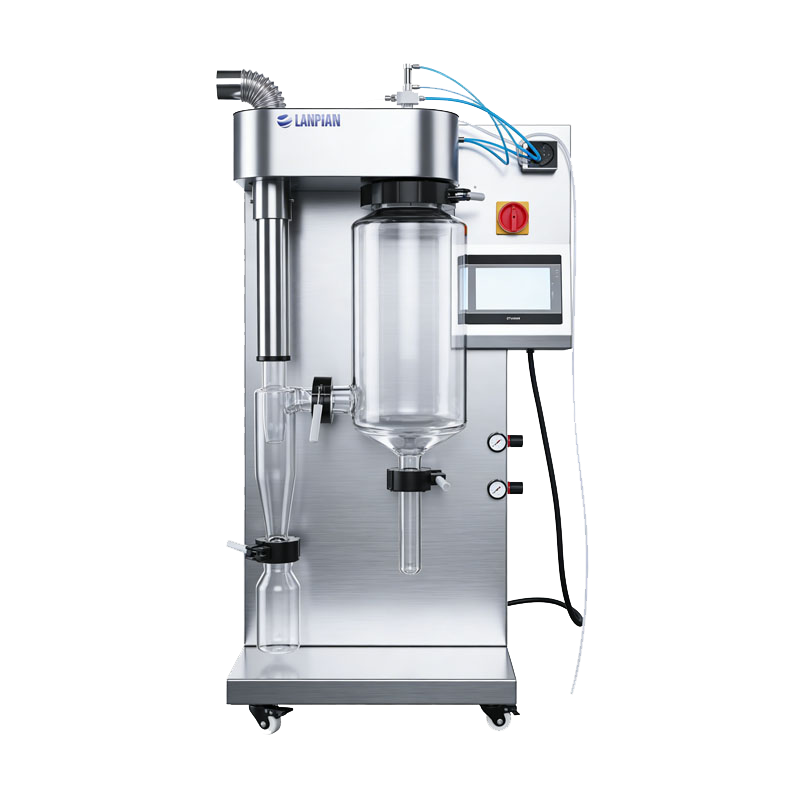
What a Lab Spray-Drying Trial Can Tell You
The first question is not simply whether the liquid can be dried. A useful trial should answer whether the feed can be delivered and atomized consistently, whether a workable inlet and outlet condition can be maintained, where product loss occurs, and what the collected powder is like.
For an R&D team, these observations help separate formulation issues from equipment issues. Heavy wall deposition may point to feed composition, solids content, temperature conditions or droplet formation. Poor collection may relate to particle size, recovery configuration or operating stability. A low powder yield should not be treated as a single machine-capacity problem until the material balance is understood.
When Lab-Scale Spray Drying Is a Good Fit
This approach is relevant when the intended product is a free-flowing or dispersible powder and the feed can be pumped and atomized safely. Typical development work includes food ingredients, plant extracts, laboratory chemicals and other solutions, suspensions or emulsions that need feasibility screening.
It is not automatically the right method for every heat-sensitive or sticky material. A feed may require formulation changes, a carrier, a different atomization approach or another drying method. Solvent-containing feeds also require a safety review and equipment designed for the solvent and operating environment. Do not put a flammable or otherwise hazardous solvent into a standard air-based laboratory unit without written confirmation that the complete system is suitable.
Define the Test Objective Before Choosing a Machine
A buyer should be able to state what the sample is expected to prove. The objective might be to produce enough powder for analysis, compare two formulations, examine wall deposition, screen operating conditions or prepare data for pilot work. These objectives do not require the same configuration.
Prepare the following information before requesting a recommendation:
- Material name and intended application.
- Liquid composition, including solvent system and any carrier.
- Solids content and how it was measured.
- Viscosity at the planned feed temperature, if known.
- Presence and approximate size of suspended particles.
- Known heat sensitivity, stickiness, foaming or corrosion concerns.
- Available sample quantity and required powder quantity.
- Powder targets such as moisture, solubility, bulk density or particle-size range.
- Cleaning, containment and material-contact requirements.
If several of these items are unknown, the correct next step may be a small feasibility trial rather than a confident capacity promise.
Run a Controlled Trial, Not a One-Off Demonstration
Start with a documented baseline. Record feed preparation, solids content, feed temperature, atomization setting, inlet and outlet conditions, airflow or pressure indications, run time, collected powder and visible deposits. Change one major variable at a time when possible. Otherwise, a better result cannot be linked to a specific adjustment.
Allow the dryer to reach a stable condition before comparing results. A short unstable period can produce powder, but it may not represent repeatable operation. Stop the trial if pressure, temperature, feed delivery or equipment behavior moves outside the approved operating limits.
Evaluate More Than the Powder Appearance
A powder can look acceptable and still be unsuitable for the project. Review the result against the intended use. Depending on the material, the evaluation may include residual moisture, reconstitution, flow, bulk density, particle distribution, retained activity or other application-specific tests.
Also account for the material that did not reach the collection vessel. Product on the chamber wall, ducting or cyclone is part of the result. Reporting only the powder in the collection bottle can hide a formulation or recovery problem.
What Lab Results Do—and Do Not—Prove About Scale-Up
A laboratory trial can establish feasibility and reveal a workable direction. It does not, by itself, guarantee production throughput, recovery, energy use or identical powder properties on a larger dryer. Airflow patterns, residence time, chamber geometry, atomizer type and collection equipment change with scale.
Before moving forward, document which variables must remain comparable and which require new pilot work. Representative feed should be used whenever possible. A trial based on a diluted, filtered or otherwise simplified sample may not describe the production feed accurately.
Equipment Questions Worth Asking Before Purchase
- Which atomization method is proposed, and why is it appropriate for this feed?
- What are the limits for viscosity, suspended particles and feed delivery?
- Which parts contact the product, and how are they cleaned and inspected?
- How are inlet, outlet and pressure conditions measured and recorded?
- What powder collection arrangement is included?
- Which utilities, exhaust provisions and installation conditions are required?
- Which operating data and maintenance documents are supplied?
- Can the proposed configuration handle the stated solvent and safety requirements?
These questions make quotations easier to compare because they focus on process fit rather than a capacity number alone.
Frequently Asked Questions
Is a laboratory spray dryer only for universities?
No. It can support university research, formulation development, quality work and small sample production. The correct use depends on the test objective, feed properties and required powder evaluation.
Does a successful lab trial guarantee production-scale performance?
No. It provides evidence for feasibility and process direction. Pilot or scale-up work may still be needed before production targets can be confirmed.
Can any liquid be spray dried?
No. Pumpability, atomization, solids content, thermal behavior, stickiness and solvent safety all affect suitability. Some feeds need reformulation or a different drying method.
What should I send with an RFQ?
Send the feed composition, solids content, solvent, viscosity or suspended-particle information, sample quantity, powder targets, cleaning requirements and intended scale. Mark unknown values clearly instead of estimating them.
Plan the Next Step Around the Sample
Review the Lanphan spray dryer range when you are ready to discuss equipment. For process fundamentals, see what a spray dryer is intended to do. If atomization method is part of the decision, compare centrifugal and two-fluid spray drying.
For a useful first review, provide the actual feed information and the decision the trial needs to support. Lanphan can then discuss whether a laboratory spray dryer is a reasonable fit and what additional information is required before a configuration is selected.
 English
  Russian
  Arabic
  Spanish