
The purpose of a spray dryer is to convert a pumpable liquid feed into a dry, collectable powder in one controlled process. The feed is atomized into droplets, contacted with heated air and separated as powder after the liquid phase evaporates. Manufacturers use spray drying when the finished product must be easier to handle, dose, blend, package or transport than the original liquid.
Spray drying does not automatically guarantee a particular particle size, shelf life, recovery rate or product quality. Those outcomes depend on formulation, atomization, drying conditions, powder collection and packaging.
The Main Purposes of Spray Drying
Convert a liquid into a free-flowing product
Solutions, emulsions and some suspensions can be processed into powder when their properties suit the selected atomizer and dryer. Removing the liquid carrier can simplify downstream weighing, mixing and packaging.
Create a defined powder form
Atomization and drying conditions influence particle size, density, shape and surface behavior. Spray drying is useful when these powder characteristics matter, but they must be confirmed by trials and measurement rather than assumed from the equipment type.
Reduce handling and transport burden
A dry powder may require less storage volume than a diluted liquid and avoids liquid leakage. The real benefit depends on the starting solids, final moisture, packaging and required reconstitution.
Support formulation and scale-up work
Laboratory and pilot spray dryers allow teams to study feed behavior, temperature limits, atomization, wall deposition and powder collection before a production-scale decision.
Prepare ingredients for later processing
Spray-dried powder may be blended, tableted, encapsulated, redissolved or used as an intermediate. The next process step should be defined early because it affects the required moisture, particle behavior and cleanliness controls.
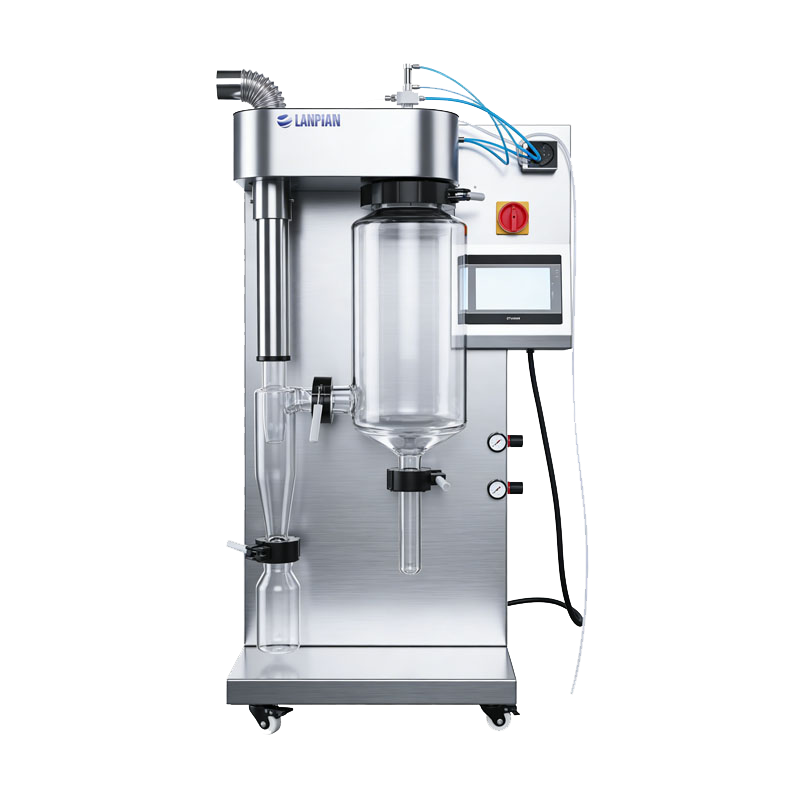
How a Spray Dryer Produces Powder
- Feed preparation: the liquid is mixed, filtered or conditioned so it remains uniform and can be pumped reliably.
- Atomization: a nozzle or rotary atomizer divides the feed into droplets.
- Drying-air contact: droplets meet heated air inside the chamber, and the volatile phase evaporates.
- Particle formation: solids remain as particles while moving through the chamber.
- Separation and collection: the cyclone, filter or other separator removes powder from the exhaust stream.
- Cleaning and documentation: collected material, wall deposition, process settings and cleaning observations are recorded.
The stages are connected. A change in feed viscosity or atomization can affect droplet size, outlet condition, deposition and recovery at the same time.
When Spray Drying Is a Good Fit
Spray drying is worth evaluating when the feed is pumpable, the product can tolerate the required process window and the project needs continuous liquid-to-powder conversion. It is often considered when rapid solvent removal and controlled particle formation are both important.
A useful feasibility check asks:
- Can the feed remain uniform during pumping?
- Can it pass through the proposed nozzle without settling or blockage?
- Is there a workable temperature window for the product?
- Can the resulting particles be separated and collected?
- Can product-contact parts be cleaned between batches?
- Is the carrier compatible with the proposed open- or closed-cycle design?
When Another Drying Method May Be Better
Spray drying may be unsuitable when the product cannot be pumped, becomes excessively sticky, degrades within the available temperature window or produces particles that cannot be recovered economically. Very small research samples may also be difficult when equipment hold-up is large compared with the available feed.
Freeze drying may be considered when low-temperature drying, porous structure or rehydration is more important than continuous processing. Tray, vacuum or fluid-bed drying may suit other product forms and production goals. The comparison should be based on the required finished material, not on a general claim that one method is always better.
Products Commonly Evaluated for Spray Drying
Food ingredients, plant extracts, flavors, proteins, cultures, ceramics, chemicals and pharmaceutical intermediates may be evaluated for spray drying. This does not mean that every formulation in these groups is suitable.
Plant extract feeds need a more specific review than a general spray-drying overview —
see the application page on spray drying extracts.
High sugar content, oils, salts, suspended particles, abrasive solids, volatile solvents and heat-sensitive components can change the process requirement. Provide the full formulation and carrier information before a supplier recommends a system.
What Determines the Finished Powder?
| Process factor | Why it matters |
|---|---|
| Feed solids and viscosity | Affect pumping, droplet formation, evaporation load and practical output. |
| Atomizer type and settings | Influence droplet distribution and the resulting particle behavior. |
| Inlet and outlet conditions | Describe the thermal and evaporation balance during the run. |
| Airflow and chamber design | Affect residence time, deposition and product movement. |
| Powder collection system | Influences loss of fine particles and usable recovery. |
| Product formulation | Controls stickiness, heat sensitivity, solubility and final structure. |
| Packaging and storage | Protect the powder from moisture, oxygen or other conditions after drying. |
Does Spray Drying Extend Shelf Life?
Drying can reduce available moisture and may improve handling or storage stability, but the equipment alone does not establish shelf life. Final moisture, water activity, oxidation, product composition, hygiene, packaging barrier and storage temperature all contribute.
Any shelf-life claim should come from product-specific testing under defined packaging and storage conditions.
Does Spray Drying Preserve Heat-Sensitive Ingredients?
Droplet cooling during evaporation can make spray drying practical for some heat-sensitive formulations, but protection is not automatic. Residence time, inlet and outlet conditions, oxygen exposure and formulation all matter.
Define the attribute that must be retained—such as activity, color, aroma or reconstitution—and measure it before and after a representative trial.
Laboratory, Pilot and Production Purposes
Laboratory equipment
Used for feasibility tests, formulation screening and small-sample process development. Visibility and easy cleaning may be more important than output.
Pilot equipment
Used to define a repeatable process window, generate evaluation batches and collect scale-up information. Feed preparation, atomization and powder recovery become more representative.
Production equipment
Used for scheduled commercial output with defined utilities, cleaning, material handling, controls and documentation. Scale-up should be based on product and process data rather than a simple multiplication of laboratory feed rate.
What Buyers Should Provide Before Quotation
- Complete feed composition and carrier.
- Solids content, viscosity and suspended-particle information.
- Available sample volume and required daily output.
- Allowable product temperature and heat-sensitive attributes.
- Target moisture, particle direction, density or reconstitution behavior.
- Required product-contact materials and cleaning approach.
- Available electrical supply, compressed air, ventilation and exhaust.
- Whether the feed contains flammable or hazardous solvents.
For model paths and project stages, review the Lanphan spray dryer selection page. Buyers comparing atomizers can also use the centrifugal vs two-fluid guide.
Frequently Asked Questions
Is spray drying only used to remove water?
No. Water is common, but other carriers may be considered in correctly engineered systems. Flammable or hazardous solvents require a specific closed-cycle and safety review; they must not be assumed suitable for a standard open system.
Does a spray dryer always make a fine powder?
No. Particle behavior depends on feed properties, atomization, process conditions and collection. The required powder should be defined and tested.
Can spray drying process suspensions?
Some suspensions can be processed, but particle size, settling, abrasion and nozzle blockage must be reviewed.
How is spray-dryer capacity determined?
Capacity depends on the volatile load, feed solids, allowable temperatures, airflow, atomization and recovery. A model name or chamber size is not enough to predict usable powder output.
Next Step
Prepare the feed and finished-powder information before choosing a model. This allows the equipment discussion to focus on a workable process rather than generic claims about speed, efficiency or capacity.
 English
  Russian
  Arabic
  Spanish