
A spray-drying project should start with the feed and the required powder—not with a model number. Lanphan reviews the material, carrier, solids, viscosity, temperature limits, powder target, project stage and available utilities before comparing equipment paths.
This page explains the information flow from an initial inquiry to trials, configuration review and quotation. It does not replace product-specific testing or promise a result without process data.
Step 1: Define the Feed Material
Provide the full formulation or a technically useful description. “Plant extract,” “food liquid” or “chemical solution” is usually not enough because materials in the same category can behave very differently.
| Feed information | Why Lanphan needs it |
|---|---|
| Carrier and composition | Determines compatibility, drying behavior and safety review. |
| Solids content | Affects evaporation load, powder output and deposition. |
| Viscosity range | Influences pumping and atomization. |
| Suspended particles | May settle, abrade parts or block flow paths. |
| Temperature sensitivity | Defines the practical process window and trial endpoints. |
| Available sample volume | Helps match trial scale and equipment hold-up. |
Step 2: Define the Powder Target
The required powder should be described in measurable terms where possible. Depending on the application, that may include final moisture, water activity, particle-size direction, bulk density, reconstitution, color, aroma, activity or flow behavior.
Not every target can be controlled independently. Changes that reduce moisture may also affect deposition or product quality. A credible project plan identifies priorities and acceptable trade-offs.
Step 3: Confirm the Carrier and Safety Requirements
Water-based feeds are common, but a water-based system must not be assumed suitable for flammable or hazardous solvents. Solvent identity, concentration and relevant safety information should be provided at the start.
Solvent-containing projects may require a closed-cycle configuration, inert gas, solvent recovery, monitoring and site-specific safeguards. Lanphan should not recommend a standard open-cycle dryer until compatibility and safety requirements are clear.
Step 4: Match the Project Stage
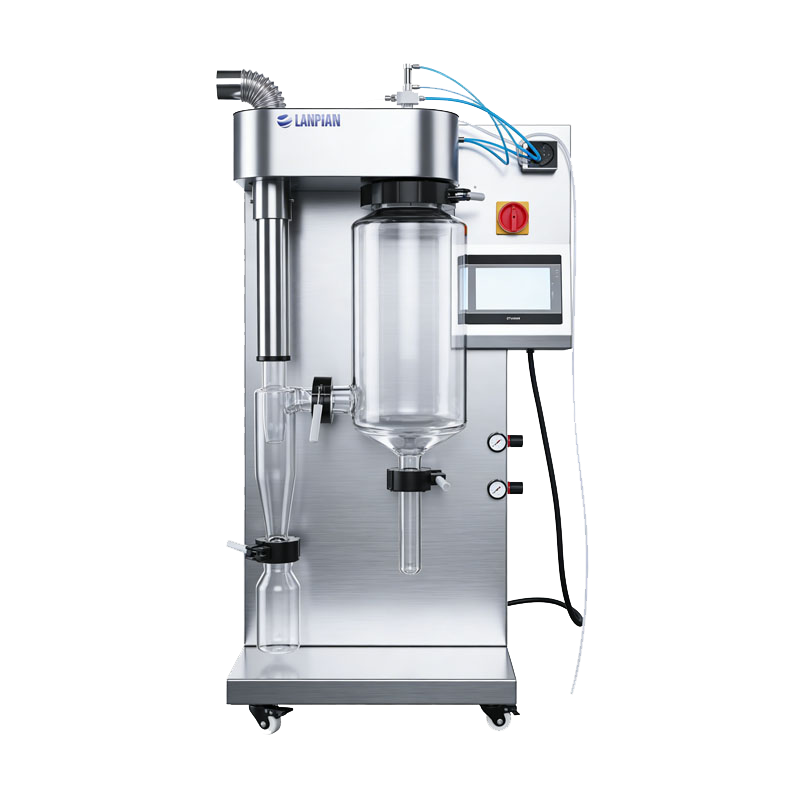
Laboratory feasibility
The priority is often to determine whether the feed can be atomized and collected without unacceptable degradation or deposition. Small sample use, visibility and cleaning access may be more important than output.
Pilot development
The project needs a repeatable process window, more representative powder, realistic collection behavior and information for scale-up. Feed preparation and run documentation become more formal.
Production planning
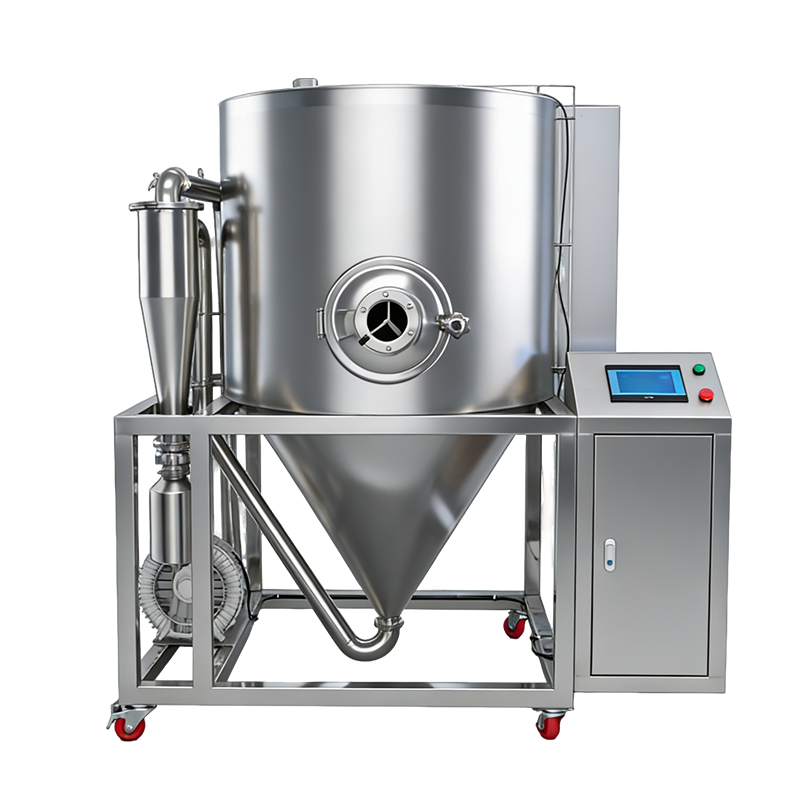
Daily output, complete cycle time, utilities, exhaust, cleaning, material handling, controls and documentation all influence the configuration. Production scale cannot be selected by multiplying a laboratory feed rate.
Step 5: Review the Atomization Method
Two-fluid nozzles use compressed atomizing gas to break the liquid into droplets. Centrifugal atomizers use rotational energy. Nozzle size, gas or rotational conditions, feed properties and desired powder behavior influence the choice.
The atomizer should be selected after reviewing viscosity, solids, suspended particles, particle target, utilities and cleaning. See the centrifugal vs two-fluid spray dryer comparison for the main trade-offs.
Step 6: Plan a Representative Trial
A useful trial does more than produce a powder sample. The team should agree on feed preparation, operating variables, sample collection and measurement before the run.
- Record feed composition, solids, viscosity and batch preparation.
- Record atomization method and relevant settings.
- Track inlet and outlet trends, feed behavior and run time.
- Separate collected powder from chamber, cyclone and filter deposition.
- Measure the agreed product endpoints.
- Document cleaning observations and changeover time.
Results should be interpreted for that formulation and scale. A successful water trial does not validate a different extract, suspension or solvent system.
Step 7: Compare Equipment Configurations
After the feed and trial objectives are clear, buyers can compare chamber and collection design, atomizer, feed system, product-contact materials, controls, data recording, cleaning access and utility demand.
Lanphan’s spray dryer selection page shows laboratory, pilot and scale-up directions. The final proposal should state which configuration assumptions are based on provided material data and which points still require confirmation.
Step 8: Confirm Utilities and Installation
Equipment selection must fit the room and available services. Confirm electrical supply, compressed air, ventilation, exhaust routing, drainage, ambient conditions, delivery access and maintenance clearance.
Also clarify how powder will be transferred after collection and how product-contact parts will be cleaned. These workflow details can determine practical daily throughput more than the nominal drying stage alone.
Step 9: Define Controls and Documentation
State which recipes, alarms, user access, sensor records, batch reports or integration points are required. A touchscreen does not automatically provide the data functions expected by every quality system.
If the site requires installation checks, calibration documents, qualification support or specific material certificates, list them before quotation.
What Lanphan Can Confirm Before a Trial
Based on complete material and project information, Lanphan can compare equipment paths, identify missing utilities, discuss atomization options and prepare a preliminary configuration.
Without representative testing, the supplier should not guarantee exact powder yield, particle size, product stability, energy use or throughput for an unfamiliar formulation. Those outcomes depend on the material and process conditions.
Information to Include in the First Inquiry
- Product and carrier description.
- Solids content, viscosity and suspended-particle details.
- Available sample and expected daily output.
- Temperature-sensitive attributes.
- Target moisture, particle direction and recovery requirement.
- Laboratory, pilot or production stage.
- Cleaning and product-contact material requirements.
- Available electrical supply, compressed air, ventilation and exhaust.
- Required controls and documents.
Frequently Asked Questions
Can Lanphan recommend a spray dryer from the product name alone?
No. Composition, solids, viscosity, carrier, temperature limits and powder targets are needed for a responsible recommendation.
Is a laboratory trial always required?
It is strongly advisable for a new or unfamiliar formulation. Existing validated process data may reduce uncertainty, but the proposed scale and configuration still require review.
Can one configuration process both water and flammable solvents?
Do not assume so. Solvent projects require a dedicated safety and system-design review and may need a closed-cycle configuration.
What data is most useful for scale-up?
Feed properties, atomization method, inlet and outlet trends, collected powder, deposition, moisture, product-specific quality results and cleaning time are all useful.
Next Step
Send a short process brief rather than only a model request. Lanphan can then identify the appropriate laboratory, pilot or scale-up discussion and list the assumptions that still need testing.
 English
  Russian
  Arabic
  Spanish