
A laboratory freeze-drying process removes water or another frozen volatile component by sublimation under reduced pressure. The frozen structure matters: it forms the paths through which vapor must travel. This is why two samples of the same mass can behave differently when their formulation, container or freezing history changes.
This guide explains the process. Buyers who need model data, tray arrangements and a purchasing checklist should use the separate laboratory freeze dryer comparison page.
Prepare the Sample Before Thinking About the Cycle
The starting sample should be described in practical terms: composition, solids level, starting moisture or solvent content, batch volume and the condition required after drying. Materials that look similar may freeze differently or form structures with very different resistance to vapor flow.
Container geometry is part of the process. A shallow layer in a tray exposes a larger surface area than the same mass held in a narrow vessel. Vials, flasks and trays also transfer heat differently. Record the container material, dimensions, fill volume and fill depth when developing a repeatable laboratory method.
- Keep sample preparation consistent between trial batches.
- Avoid assuming that wet mass alone defines the drying load.
- Record fill depth and container arrangement, not just container count.
- Confirm equipment compatibility before processing solvent-bearing samples.
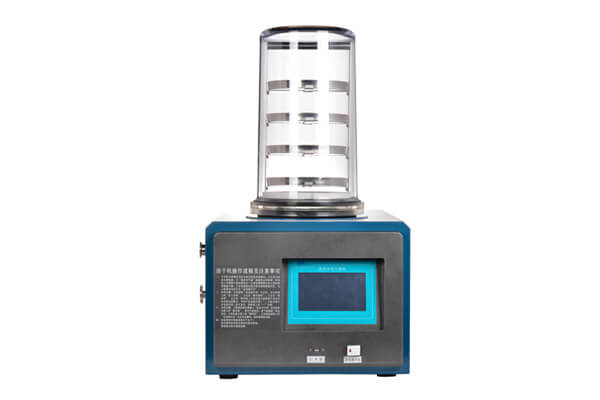
The Three Parts of a Freeze-Drying Cycle
Freezing
The sample is frozen before sublimation begins. The freezing history influences crystal structure and the paths available for vapor movement. Uneven freezing can produce uneven drying, particularly when fill depth varies between containers.
Primary drying
Under reduced pressure, heat is supplied carefully so the frozen component can sublime. The product must receive enough energy to sustain sublimation without exceeding the limit that protects its frozen structure. Most of the removable frozen water leaves during this stage.
Secondary drying
After visible ice is no longer the main source of moisture, the process continues to reduce more tightly bound moisture. The suitable endpoint depends on the material and the condition required for storage or further processing; it should not be assumed from time alone.
What Vacuum and the Cold Trap Actually Do
Reduced pressure creates the conditions needed for sublimation, but the vacuum reading by itself does not prove that the product is drying correctly. Product temperature, heat input, vapor flow and condenser demand remain connected. A leak, excessive vapor load or restricted flow can change the behavior of the cycle even when the sample and set points appear unchanged.
The cold trap receives vapor from the drying chamber and condenses it away from the vacuum system. Its temperature is therefore a process limit to review against the material, but a colder published value does not automatically make one configuration correct for every sample. The expected vapor load and material characteristics must still be considered.
Loading Format Changes Heat and Mass Transfer
Trays
Trays are useful for bulk material and samples that can be spread to a controlled depth. Record the mass per tray and keep the layer reasonably consistent. Increasing layer depth may reduce exposed surface area relative to the load and extend the path vapor must travel.
Vials
Vials divide the batch into many small units. Fill volume, vial diameter, stopper position and shelf arrangement all affect the usable load. If stoppering inside the chamber is required, it must be treated as a specified equipment function rather than assumed from a general laboratory configuration.
Flasks and other vessels
Flasks and non-standard vessels require attention to connection method, vessel dimensions and available chamber space. Their suitability cannot be established from tray count. Confirm the exact arrangement before a model is selected.
How to Read a Laboratory Trial
A useful trial records what happened, not only whether the sample looked dry at the end. At minimum, preserve the sample formulation, starting load, container layout, freezing method, process settings, observations during the cycle and the endpoint check used for the material.
Common process questions include:
- Did all containers freeze under comparable conditions?
- Was the product layer consistent across the chamber?
- Did vapor load rise sharply after a change in heat input?
- Was the endpoint checked by a method appropriate to the sample?
- Can the same preparation and loading method be repeated?
Where Laboratory Work Ends and Scale-Up Begins
Laboratory work is suited to sample preparation, feasibility testing and cycle development at limited load. The project begins to move toward pilot scale when repeatability across larger loads, scheduled production-like batches or more explicit shelf and closure control becomes part of the requirement.
Scale-up is not a simple multiplication of wet mass. Heat-transfer area, product depth, vapor flow and condenser demand change with the equipment and loading arrangement. Preserve the laboratory process record so the pilot review starts from measured conditions rather than a general description.
 English
  Russian
  Arabic
  Spanish