
Most failed home freeze-drying batches are not caused by one dramatic machine fault. They usually start with the food, tray loading, incomplete dryness or packaging that allows moisture back in. The checks below are based on guidance from university extension programs and should be used together with the instructions for your specific freeze dryer.
Food-safety note: freeze drying removes water, but it is not a kill step for illness-causing microorganisms. Start with safely handled food, prevent cross-contamination and follow current safe cooking guidance for foods that will be eaten after rehydration.
1. Choosing Foods That Do Not Freeze-Dry Reliably
Foods with a high fat or oil content do not release moisture in the same way as lean foods. Very sugary or syrupy products can remain sticky. The University of Minnesota Extension notes that home units work well for many fruits, vegetables, dairy foods and proteins, but not for foods high in fat, high in sugar or many baked goods.
Better approach: begin with a food that has established home freeze-drying guidance. If the formulation is oily, syrupy or unusually dense, test a small quantity and do not assume a longer cycle will solve a fundamental material problem. See our guide to foods that can and cannot be freeze dried for an equipment-oriented overview.
2. Treating Freeze Drying as a Food-Safety Treatment
Freezing and vacuum drying do not make contaminated food safe. Microorganisms that are present before processing can survive and become active again after moisture is added. Raw meat, poultry, seafood and eggs require particular care.
Better approach: clean and sanitize food-contact surfaces, wash produce correctly, prevent allergen cross-contact and use safe preparation temperatures. Clearly label foods as raw or cooked. Foods that require cooking should reach the applicable safe internal temperature after rehydration and before eating.
3. Cutting Pieces to Different Thicknesses
Thin and thick pieces in one batch will not finish together. A surface can feel dry while the center of a thicker piece still contains moisture.
Better approach: cut pieces to a consistent thickness and group foods with similar structures and expected drying behavior. Uniform preparation is more useful than trying to correct an uneven load with a single extra-time setting.
4. Overfilling Trays or Building Thick Piles
Piles and overloaded trays create inconsistent heat and vapor-removal paths. Some foods also expand during drying. Filling beyond the tray edge can interfere with loading and may not match the equipment instructions.
Better approach: spread prepared food evenly in a single layer and remain within the tray and batch limits stated by the manufacturer. When more product is available, two controlled batches are preferable to one overloaded batch.
5. Treating a Typical Cycle Time as a Guarantee
The UCCE Master Food Preservers material gives 20–40 hours as a typical range and notes that dense or high-sugar foods may take longer. That is a planning reference, not a universal setting. Food composition, piece size, initial freezing, load quantity, room conditions and equipment design all affect the cycle.
Better approach: follow the machine program and manufacturer instructions, then verify dryness before packaging. Do not shorten a cycle because another food or another brand finished sooner.
6. Ignoring the Installation Environment
A hot, enclosed space can make refrigeration and heat rejection more difficult. A very cold location may also fall outside the operating range. The UCCE guide discusses 45–80°F (about 7–27°C) as a typical ambient range for home equipment, but the approved range for the actual model takes priority.
Better approach: confirm ventilation clearance, ambient limits, electrical supply, drainage and vacuum-pump placement in the equipment documentation. Keep air paths clear and do not improvise an enclosure around the unit.
7. Checking Only One Piece for Dryness
A machine can process different tray positions or food sizes unevenly. Testing the easiest piece may miss moisture elsewhere in the load.
Better approach: sample more than one tray and choose some of the thickest pieces. Cut them open and inspect the center. The University of Minnesota recommends returning all trays for more drying when a sample shows a dark, moist center. Follow the model instructions for adding dry time safely.
8. Leaving Finished Food Exposed to Room Air
Freeze-dried food readily absorbs moisture. Even normal kitchen humidity can soften the product and undermine storage conditions.
Better approach: prepare clean, dry containers and labels before the cycle finishes. Package promptly in small working groups rather than leaving the entire batch exposed while each container is prepared.
9. Using Packaging That Is Not a Moisture Barrier
A bag can be heat-sealable without providing an adequate long-term moisture barrier. Some general food-storage or sous-vide bags allow more moisture and oxygen transmission than packaging designed for dry storage.
Better approach: use food-grade, moisture-proof, hermetically sealed packaging appropriate for the intended storage period. University guidance lists options including suitable Mylar bags, moisture-barrier bags and vacuum-sealed Mason-style jars. Use oxygen absorbers or desiccants only as directed for the packaging and food; they do not compensate for a poor seal. Label the product, preparation date and whether it was packed raw or cooked.
10. Repeating a Shelf-Life Claim Without Evidence
Very long shelf-life statements generally refer to commercially processed products stored under controlled conditions. University of Minnesota Extension notes that information on the shelf life of food produced in home freeze dryers is still limited.
Better approach: avoid promising a fixed number of years. Store sealed packages in a cool, dry location, inspect seals and package condition, rotate stock and discard food when safety or package integrity is uncertain.
11. Assuming Freeze Drying and Dehydrating Are Interchangeable
Both processes remove moisture, but they do so differently. Freeze drying freezes the product and removes ice under vacuum through sublimation. A dehydrator uses heated moving air. The resulting texture, rehydration, cycle, equipment and packaging needs are different.
Better approach: choose from the required result backward. A dehydrator may be appropriate for a simple dried snack. Freeze drying may be considered when a porous structure and rehydration are important, provided the food and safety procedure are suitable.
A Five-Point Pre-Run Checklist
- Confirm that the food is suitable and has been handled safely.
- Prepare pieces to a consistent thickness.
- Load a single layer within the equipment limits.
- Prepare verified moisture-barrier packaging before the cycle ends.
- Plan to test several pieces and tray positions before sealing.
Frequently Asked Questions
Does freeze drying kill bacteria?
No. University extension guidance states that the process does not kill illness-causing microorganisms. Safe handling, cooking and storage requirements still apply.
How can I tell whether a batch is completely dry?
Follow the equipment instructions and inspect samples from multiple trays, including thick pieces. Cut samples open and check the center. Return the load for additional drying if any sample remains moist.
Should every home batch use Mylar bags and oxygen absorbers?
No single package is correct for every food or storage period. The container must be food-grade, moisture-proof and hermetically sealed. Absorbers and desiccants must be compatible with the food, packaging and manufacturer instructions.
Equipment Information
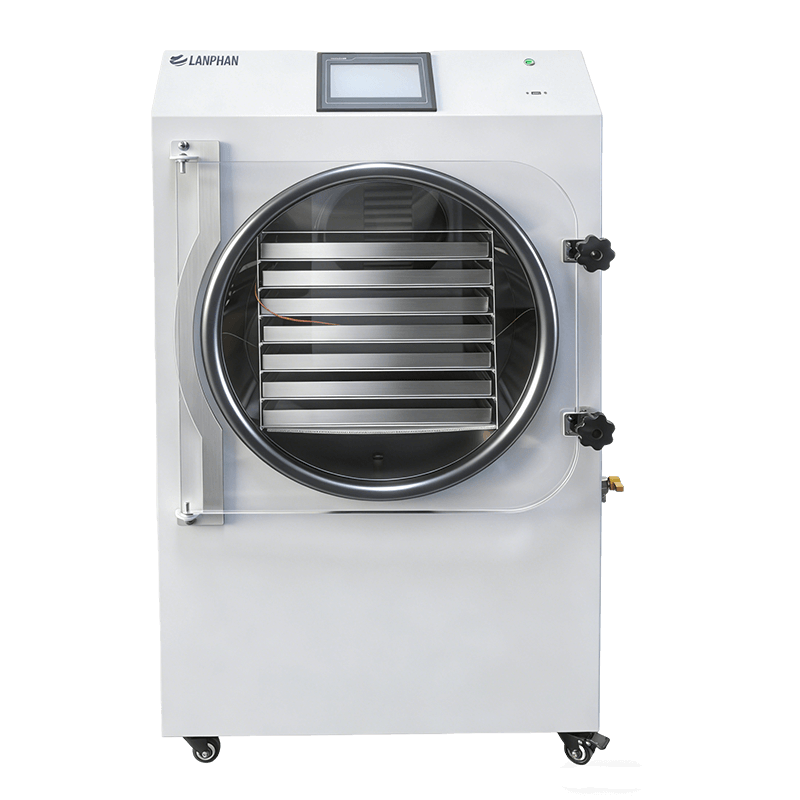
If you are comparing machines, review the Lanphan home freeze dryer range. For larger laboratory or production requirements, see the broader freeze dryer range. Before purchase, confirm tray capacity, utilities, installation conditions, vacuum system, maintenance requirements and the operating documentation supplied with the proposed model.
Sources reviewed: University of Minnesota Extension: Preserving Food at Home—Freeze-Drying and UCCE Master Food Preservers: Freeze Drying for Home Use.
 English
  Russian
  Arabic
  Spanish