
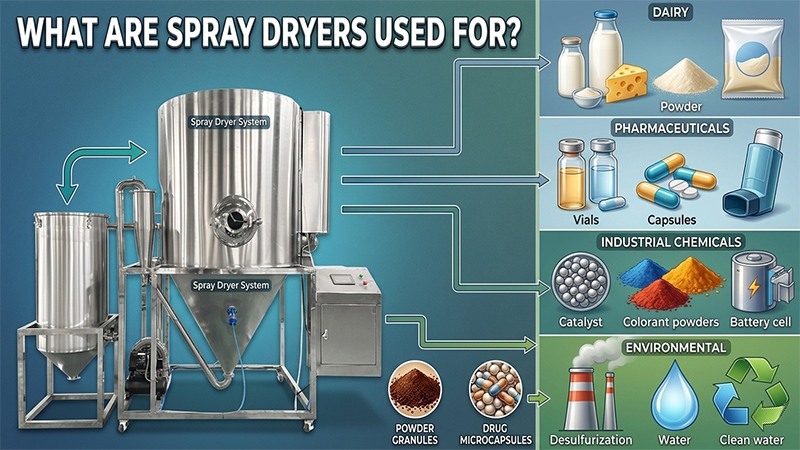
what are spray dryers used for?
I.Introduction
Spray drying is a highly efficient drying technique in which a liquid (such as a solution, suspension or emulsion) is atomised into micron-sized droplets, which come into instantaneous contact with a hot medium (usually hot air), causing the water to evaporate rapidly and directly converting the liquid into a powdered or granular solid product in a single step. This drying method is extremely efficient. It offers rapid drying speeds (on the order of seconds), allows for continuous processing, produces particles of uniform size, and ensures consistent powder quality
II. Main Industrial Applications of Spray Dryers
1. Food and Beverage Industry
Spray drying is widely used in the food and beverage industry, for example: milk powder, coffee powder, matcha powder, etc. It extends shelf life, improves solubility, and enables precise control over particle characteristics.
Dairy products: whole milk/skimmed milk powder, whey powder, infant formula.
Beverages: Instant coffee, instant tea, fruit juice powder, plant-based milk powder (soya milk, oat milk).
Condiments and Additives: Extract powders, microencapsulation of flavourings and aromas (to lock in aroma), natural colourings.
2. Pharmaceuticals & Biotechnology
In the pharmaceutical industry, it is used not only for drying but also for ‘formulation design’. Building on this, optimal drug delivery is achieved through the control of particle size.
Drug excipients: Regularly shaped particles that are easy to tableting.
Thermosensitive drugs: Manufacture of antibiotics, vaccines and enzyme preparations (by briefly exposing them to high temperatures to preserve the activity of the active ingredients).
Inhalation formulations: Production of powders with specific fine particle sizes so that the drug can enter the lungs directly.
3. Chemical and Materials Industry
Ceramic materials: Production of precision ceramic powders and speciality abrasives.
Polymers and resins: Detergent powders, catalysts, synthetic rubber, etc.
Pigments and dyes: Production of uniform powdered colourants, facilitating storage and transport.
4. Environmental Protection and Waste Treatment
Desulphurisation processes: In flue gas treatment at power stations, the spray drying principle is utilised to absorb acidic gases (dry desulphurisation).
Zero discharge of industrial wastewater: Certain high-salinity wastewater is spray-dried into solid salts, facilitating recovery, reuse or landfill disposal.
5. Laboratory & Research Applications
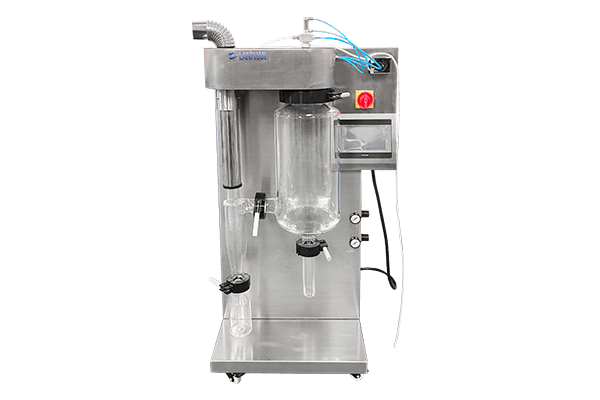
Pilot-scale spray drying is suitable for high-value samples or research-level experiments, such as the drying and granulation of small sample quantities.
III. Conclusion
Spray drying allows for precise control of particle size distribution, residual moisture content, bulk density and particle shape, making it particularly suitable for heat-sensitive materials such as biopharmaceuticals. Its rapid drying rate (instantaneous evaporation of moisture), wide range of applications (liquids, slurries, suspensions) and ability to preserve active ingredients (particularly for heat-sensitive materials) make it an indispensable piece of equipment in the food, pharmaceutical, chemical and agricultural sectors.
 English
  Russian
  Arabic
  Spanish