
A 3L two-fluid spray dryer is a pilot-stage option for teams that need more process information than a basic small-sample trial can provide. Two-fluid atomization uses a liquid feed and compressed atomizing gas at the nozzle. The gas breaks the liquid into droplets before they contact the drying air; it does not simply mean that two liquid products are processed together.
Model suitability depends on feed composition, solids content, viscosity, temperature limits, powder target and available utilities. The “3L” model description should not be treated as a guaranteed feed rate or powder output for every formulation.
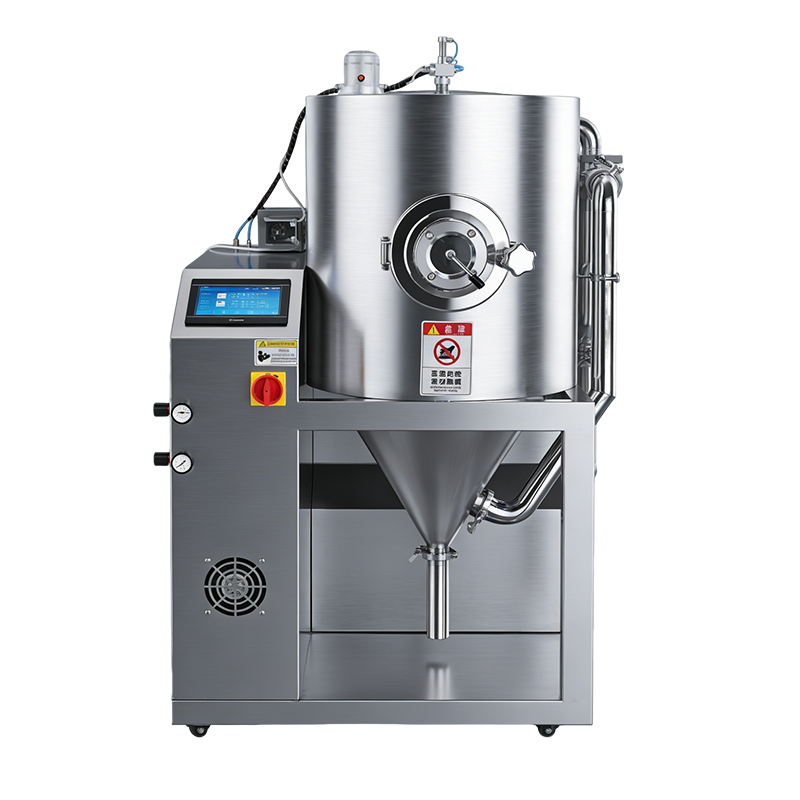
When a 3L Two-Fluid Spray Dryer Fits
This configuration is most relevant when a project is moving from initial feasibility work toward repeatable pilot trials. It can help a team study how feed conditions, atomizing gas, temperature and collection behavior interact before specifying a larger dryer.
It is not automatically the right choice for high-viscosity feeds, strongly abrasive suspensions, highly sticky products or flammable solvents. These require a material and safety review, and sometimes a different atomizer or system design.
How Two-Fluid Atomization Works
The nozzle brings liquid feed and compressed gas together. Gas velocity provides the energy that breaks the liquid into droplets. Those droplets enter the drying chamber and contact heated process air. Moisture evaporates, and the remaining particles are separated from the exhaust stream by the configured collection system.
Droplet size is influenced by liquid flow, gas flow, nozzle geometry, viscosity, surface tension and solids content. Changing one setting can affect outlet condition, wall deposition and powder recovery, so trials should record the complete operating window rather than one “best” setting.
For a broader atomizer comparison, see centrifugal vs two-fluid spray dryers.
Feed Information to Review Before a Trial
| Feed detail | Selection impact |
|---|---|
| Composition and carrier | Determines material compatibility, drying behavior and safety requirements. |
| Solids content | Affects evaporation load, powder output and deposition risk. |
| Viscosity range | Influences pumping and nozzle atomization. |
| Suspended particles | May settle, abrade parts or block a small flow path. |
| Allowable temperature | Defines the usable drying window for sensitive materials. |
| Target moisture and particle form | Provides measurable trial endpoints. |
| Cleaning requirements | Influences product-contact materials, access and changeover planning. |
What to Measure During Pilot Testing
A useful pilot run should produce more than a sample bag. Record feed preparation, solids, viscosity, liquid flow, atomizing-gas condition, inlet and outlet trends, run time, collected powder, wall deposition and cleaning observations.
- Evaluate whether the feed remains uniform during the run.
- Check nozzle stability and any sign of pulsing or blockage.
- Measure product-specific endpoints such as moisture or reconstitution using an agreed method.
- Separate collected powder from material left in the chamber, cyclone and filter path.
- Document what changes were made and how the powder responded.
These records help determine whether the formulation is ready for scale-up or still requires development.
Powder Collection and Wall Deposition
Fine particles can follow the exhaust stream, while sticky material may adhere to the chamber or collection path. Recovery depends on the formulation, droplet distribution, drying conditions and separator design. A generic recovery claim has little value without the product and test conditions.
Ask how the proposed system handles fine powder, how product loss is measured and which parts are accessible for inspection. If powder recovery is a key commercial requirement, include it as a defined trial endpoint.
Temperature and Heat-Sensitive Products
Spray drying exposes droplets to heated air, but the product response depends on evaporation and residence time. Inlet and outlet air temperatures are process indicators; neither is automatically the exact particle temperature.
Heat-sensitive projects should define the attribute that must be protected, such as activity, color, aroma or reconstitution. That attribute should be tested before and after drying rather than inferred from the equipment setting.
Compressed Air, Utilities and Installation
Two-fluid atomization requires a stable source of clean compressed gas at the conditions specified for the nozzle. Also confirm electrical supply, room ventilation, exhaust routing, drainage, ambient temperature, installation clearance and access for cleaning.
Compressed-air quality matters when gas contacts the product. The buyer should define filtration and quality requirements according to the application and site procedures.
Cleaning and Changeover
Review access to the feed vessel, pump line, nozzle, chamber, cyclone and collection vessel. Sticky, strongly colored or biologically active products may require more time and a more defined cleaning procedure. Ask which parts are removable, which seals are routine wear items and how cleaning completion is checked.
For multi-product use, include cleaning and drying time in the practical batch schedule. A short spray run followed by a long changeover may limit daily throughput.
Questions to Include in a 3L Two-Fluid Spray Dryer RFQ
- What is the complete feed composition, solids content and viscosity?
- Are particles suspended in the feed, and do they settle?
- Which carrier is used, and is it flammable or hazardous?
- What powder moisture, particle direction and recovery target are required?
- Which compressed-gas supply and quality are available?
- What utilities, ventilation and exhaust arrangements are available?
- How are the nozzle, chamber and collection path cleaned?
- Can a representative feed trial be completed before final configuration?
Frequently Asked Questions
Does “two-fluid” mean two liquid feeds?
No. In this atomization method, the two fluids are normally the liquid feed and compressed atomizing gas.
Is the 3L description a guaranteed capacity?
No. Practical feed and powder output depend on composition, solids, viscosity, temperature window, atomization and recovery behavior.
Can the dryer process solvent-based feeds?
Do not assume so. Flammable or hazardous solvents require a specific safety and system-design review. A standard open-cycle dryer may be unsuitable.
What is the purpose of pilot testing?
Pilot testing helps define a stable operating window, identify powder loss or deposition, evaluate product quality and collect information for scale-up.
Next Step
Send the feed composition, solids, viscosity, carrier, target powder and planned batch schedule. Lanphan can then compare the 3L two-fluid model with other spray dryer options without relying on nominal model names alone.
 English
  Russian
  Arabic
  Spanish