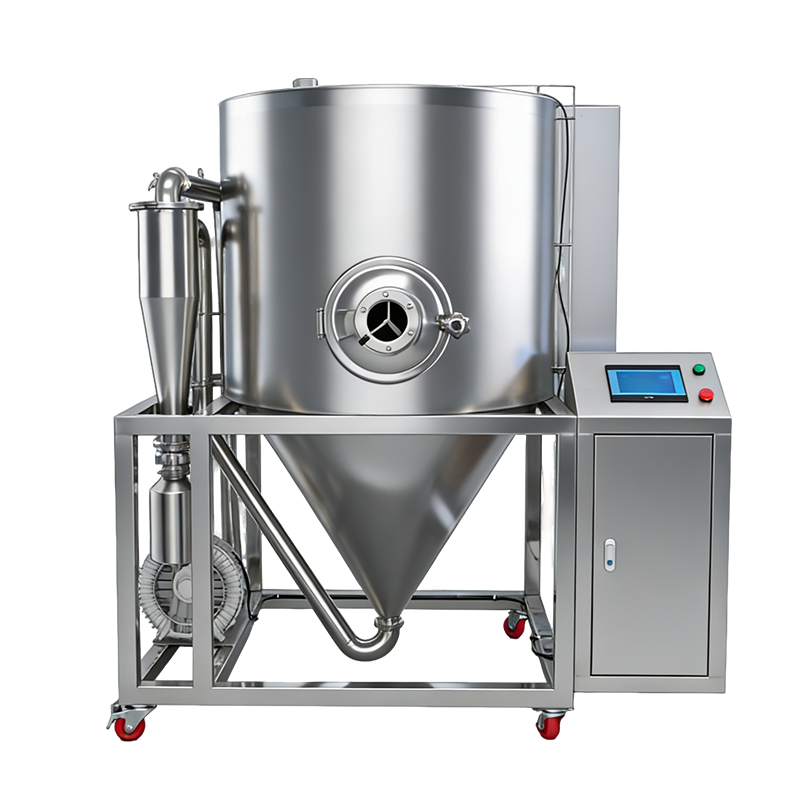
Spray Dryer Manufacturer for Lab, Pilot and Industrial Production

Lab to industrial capacity / Glass & stainless steel / Food, pharma, chemical / OEM customization / Global shipping

Why Buyers Choose Lanphan

Built for lab research, pilot trials, and industrial powder production.

ISO 9001 & CE Certified

Highest safety & quality standards

16+ Years Expertise

Pioneering manufacturing since 2007

Global Reach

Trusted by clients in 100+ countries

Overseas Warehouses

Stock in USA, Canada, Australia

Since 2007

Supporting powder processing projects with practical engineering and export experience.

Lab To Industrial Systems

From lab trials to scale-up and full production deployment.

Glass & Stainless Steel Designs

Material options to match hygiene, corrosion, and process requirements.

Food, Pharma & Chemical Use

Configurations tailored for food, pharmaceutical, chemical, and specialty materials.

OEM Customization

Flexible configurations based on your feed properties and output goals.

Global Shipping Support

Export support for overseas installation, documents, packing, and delivery.

Choose the Right Spray Dryer for Your Application

Compare Lanphan spray dryer models by capacity, atomization method, material, and typical application. This helps you quickly identify the right system for lab testing, pilot trials, or industrial production.

Model Capacity Atomization Type Material Best For Industry Key Advantage
2L Glass Spray Dryer 1500~2000ml/h Two-fluid (1.00mm) Borosilicate Glass & SS Lab R&D, early concept validation Pharma, Academic, Materials 360° transparent visual monitoring
2L Stainless Steel Spray Dryer 1500~2000ml/h Two-fluid (1.00mm) SUS304 / SUS316L SS Standard lab tests requiring durability Food, Beverage, Chemical High mechanical strength and crash resistance
3L Two Fluid Spray Dryer 3000ml/h Two-fluid (1.00mm) Industrial Stainless Steel Pilot scale, precise particle control Pharma, Fine Chemicals Uniform particle size, 1.0~1.5s fast drying
3L Centrifugal Spray Dryer 1500~3000ml/h Centrifugal (36000r/min) Industrial Stainless Steel Handling high-viscosity or dense slurry Food (Dairy), Ceramics, Catalysts Anti-clogging, stable continuous output
LPSD-5 Spray Dryer 5000ml/h (5kg/h) Centrifugal Atomizer Industrial Stainless Steel Pilot to commercial scale-up Pharma APIs, Cosmetics, Bulk Food 13KW high power, precise intelligent control

Spray Dryer Models & Specifications

Our spray dryers come in various models to suit different scales of production, from laboratory applications to large-scale industrial needs. Below are some of the key models available:

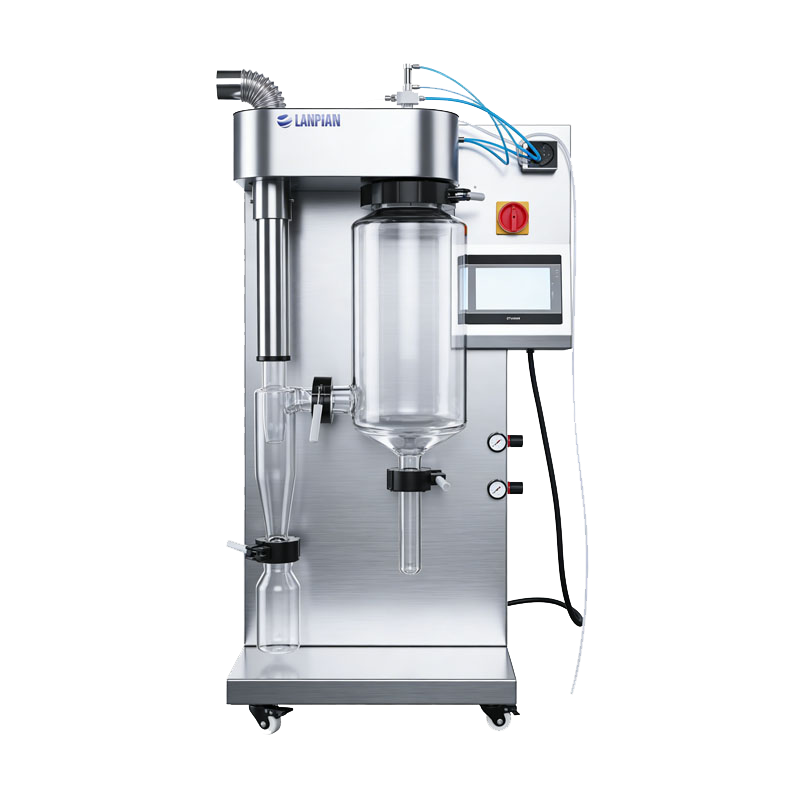
2L Glass Spray Dryer

2L Glass Spray Dryer

  A lab spray dryer for R&D and early concept validation, with 360° transparent visual monitoring during the process.

  •   Capacity: Water evaporation capacity 1500–2000 ml/h; max. feed rate 2000 ml/h.
  •   Atomization: Two-fluid nozzle, 1.00 mm.
  •   Material: Borosilicate glass and stainless steel.
  •   Power / Airflow: Heater power 3.5 kW, AC 220 V; max. airflow 5.6 m3/min.

  Suitable for lab R&D, early-stage validation, and applications in pharma, academic, and materials work where visual process observation is important.

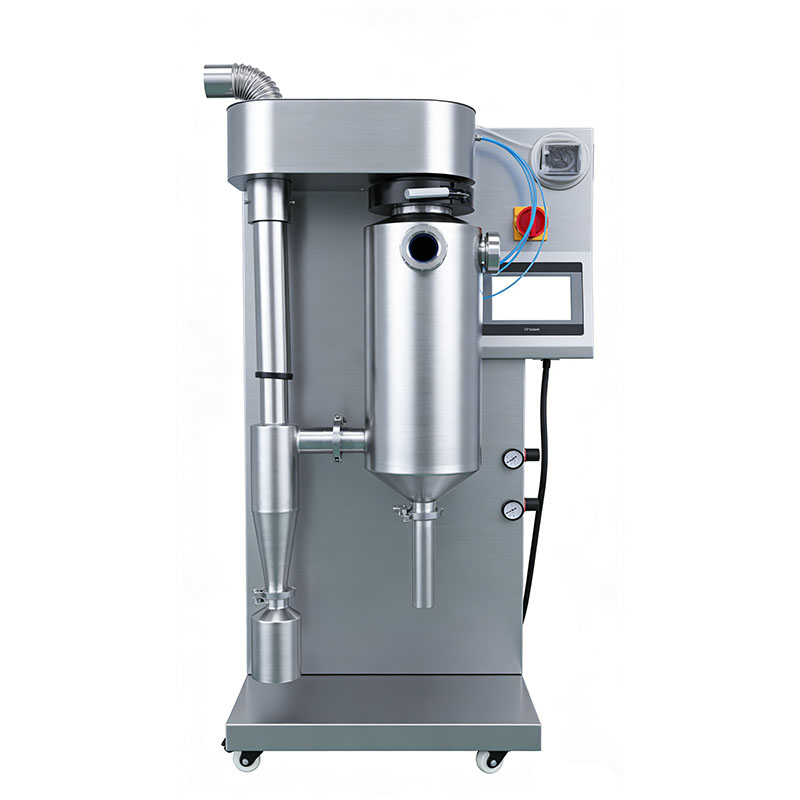
2L Stainless Steel Spray Dryer

2L Stainless Steel Spray Dryer

  A durable lab spray dryer for standard testing where higher mechanical strength and crash resistance are required.

  •   Capacity: Water evaporation capacity 1500–2000 ml/h; max. feed rate 2000 ml/h.
  •   Atomization: Two-fluid nozzle, 1.00 mm.
  •   Material: SUS304 / SUS316L stainless steel.
  •   Power / Airflow: Electric heater 3.5 kW, AC 220 V; max. airflow 5.6 m3/min.

  Suitable for standard lab tests in food, beverage, and chemical applications where a stainless steel structure is preferred

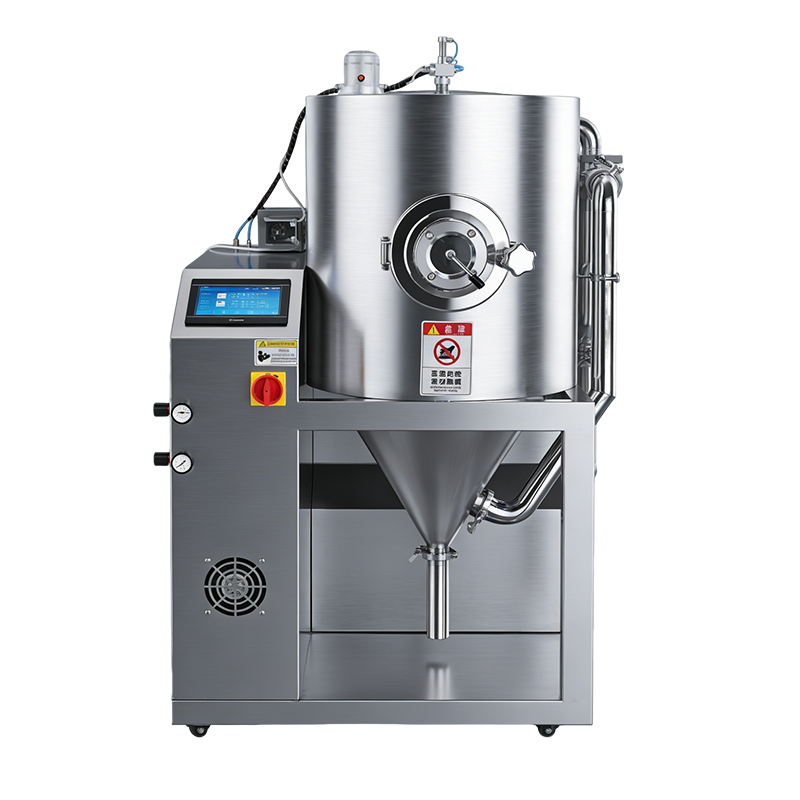
3L Two fluid spray dryer

  A pilot-scale spray dryer for processes that need precise particle control, uniform particle size, and fast drying.

  •   Capacity: Water evaporation capacity 3000 ml/h; max. feed rate 3000 ml/h, adjustable.
  •   Atomization: Two-fluid nozzle, 1.00 mm.
  •   Material: Industrial stainless steel.
  •   Power / Airflow: Draught fan 0.55 kW, 100 m3/h; drying time 1.0–1.5 s.

  Suitable for pilot-scale work in pharmaceuticals and fine chemicals where particle consistency and short drying time matter.

3L Centrifugal spray dryer

3L Centrifugal spray dryer

  A pilot spray dryer for handling high-viscosity or dense slurry, with anti-clogging performance and stable continuous output.

  •   Capacity: Water evaporation capacity 1500–3000 ml/h; max. feed rate 3000 ml/h, adjustable.
  •   Atomization: Centrifugal atomization, 36,000 rpm.
  •   Material: Industrial stainless steel.
  •   Power / Airflow: Exhaust fan 0.75 kW, 140 m3/h; drying time 1.0–1.5 s.

  Suitable for pilot applications in food, especially dairy-related processing, as well as ceramics and catalysts where denser feed materials need stable atomization.

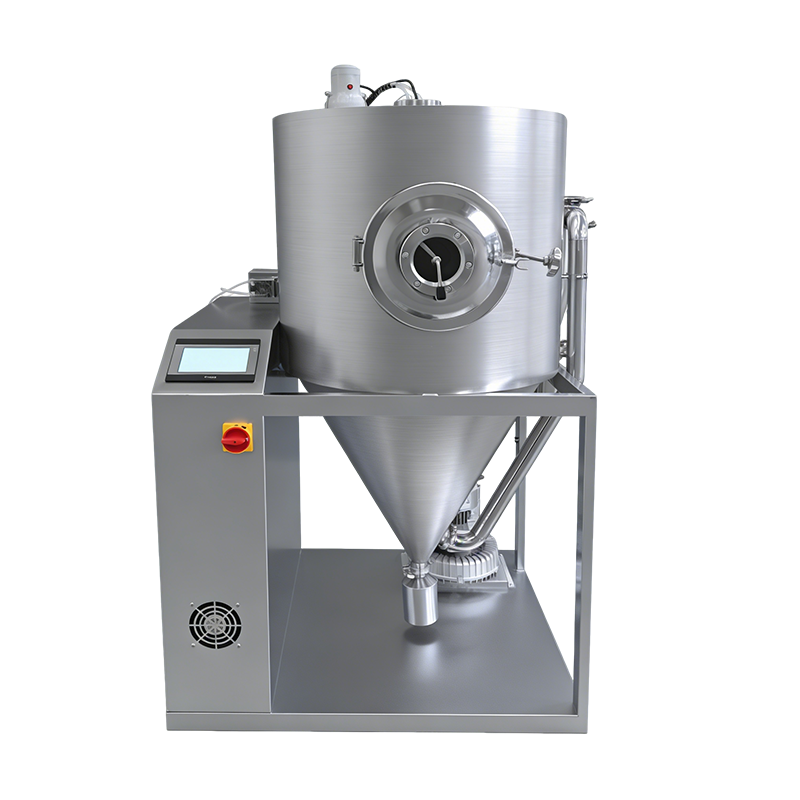
LPSD-5 Spray dryer

LPSD-5 Spray dryer

  A larger spray dryer for pilot-to-commercial scale-up, with precise intelligent control and higher overall machine power.

  •   Capacity: 5000 ml/h (5 kg/h); minimum feed amount 50 mL/h.
  •   Atomization: Centrifugal atomizer.
  •   Material: Industrial stainless steel.
  •   Power / Airflow: Machine power 13 kW, 380 V; electric heater power 9 kW; draught fan 3 kW, maximum wind velocity 360 m3/h.

  Suitable for pilot to commercial scale-up in pharma APIs, cosmetics, and bulk food production where higher capacity and controlled operation are required.

How Does a Spray Dryer Work?

The spray drying process involves several key stages:

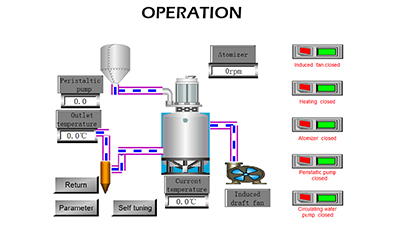
  • Atomization: The liquid or slurry is atomized into fine droplets by an atomizer.
  • Drying: The droplets are exposed to hot air or gas, causing the moisture to evaporate rapidly, turning the droplets into dry powder.
  • Separation: The dried powder is then separated from the air stream using a cyclone or filtration system.

This process is ideal for drying heat-sensitive materials, ensuring high-quality powders without degradation of active ingredients.

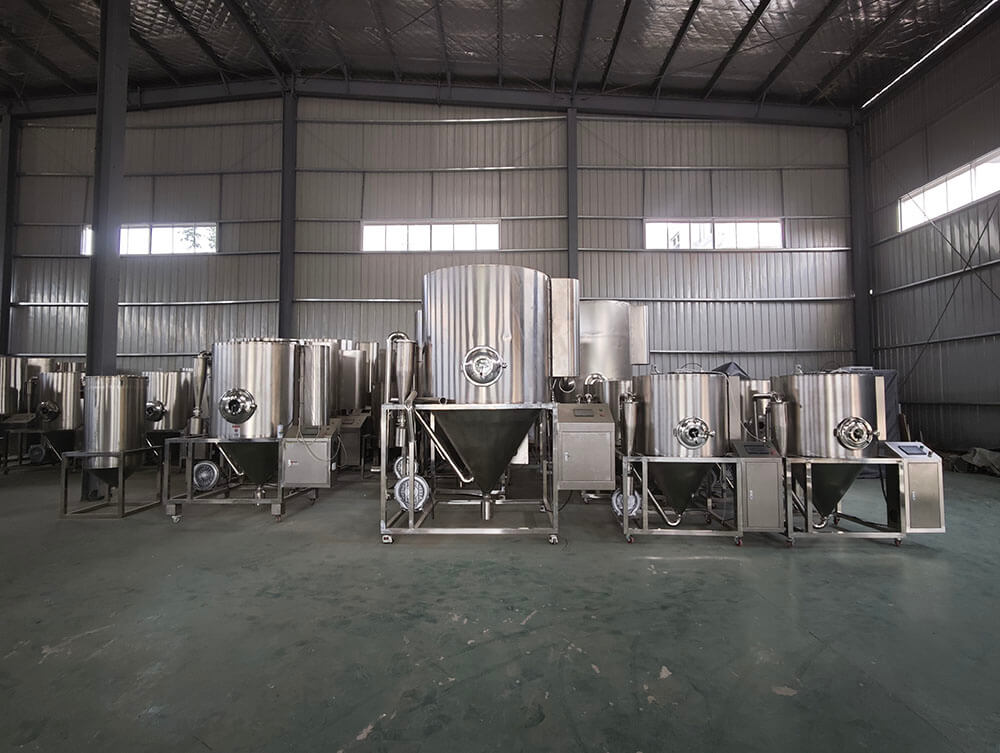
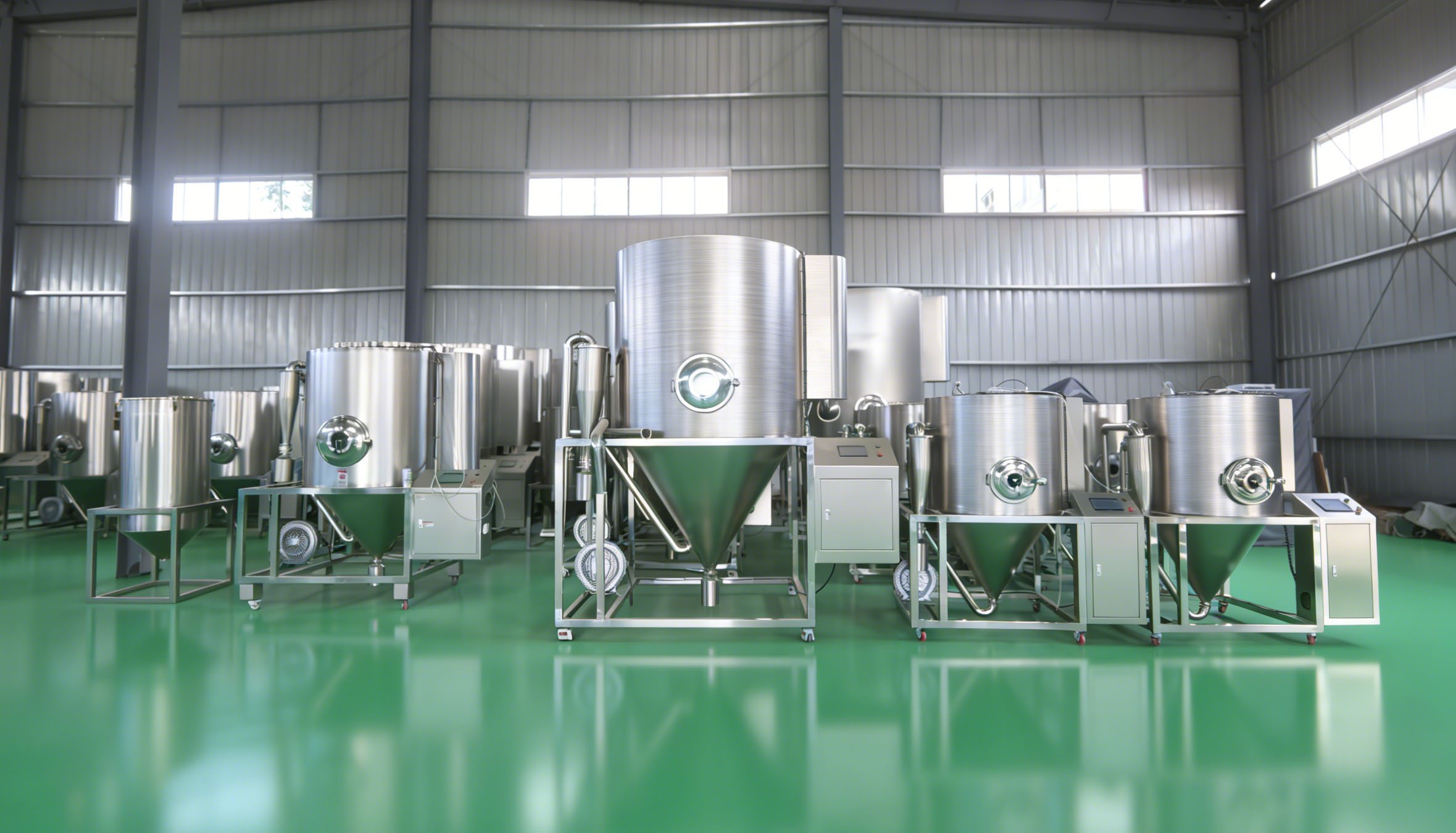
Spray dryer production workshop

Why Choose a Spray Dryer?

Efficient Drying

Unique spray technology rapidly atomizes the liquid, facilitating swift interaction with hot air and achieving high-efficiency drying to enhance production efficiency.

Customized Particle Size

Precise control of the final powder’s particle size is achievable by adjusting operational parameters, meeting specific requirements for particle size in different products

Product Quality Assurance

The rapid execution during the drying process reduces exposure time for heat-sensitive substances, aiding in maintaining product quality and the integrity of active ingredients.

Wide Applicability

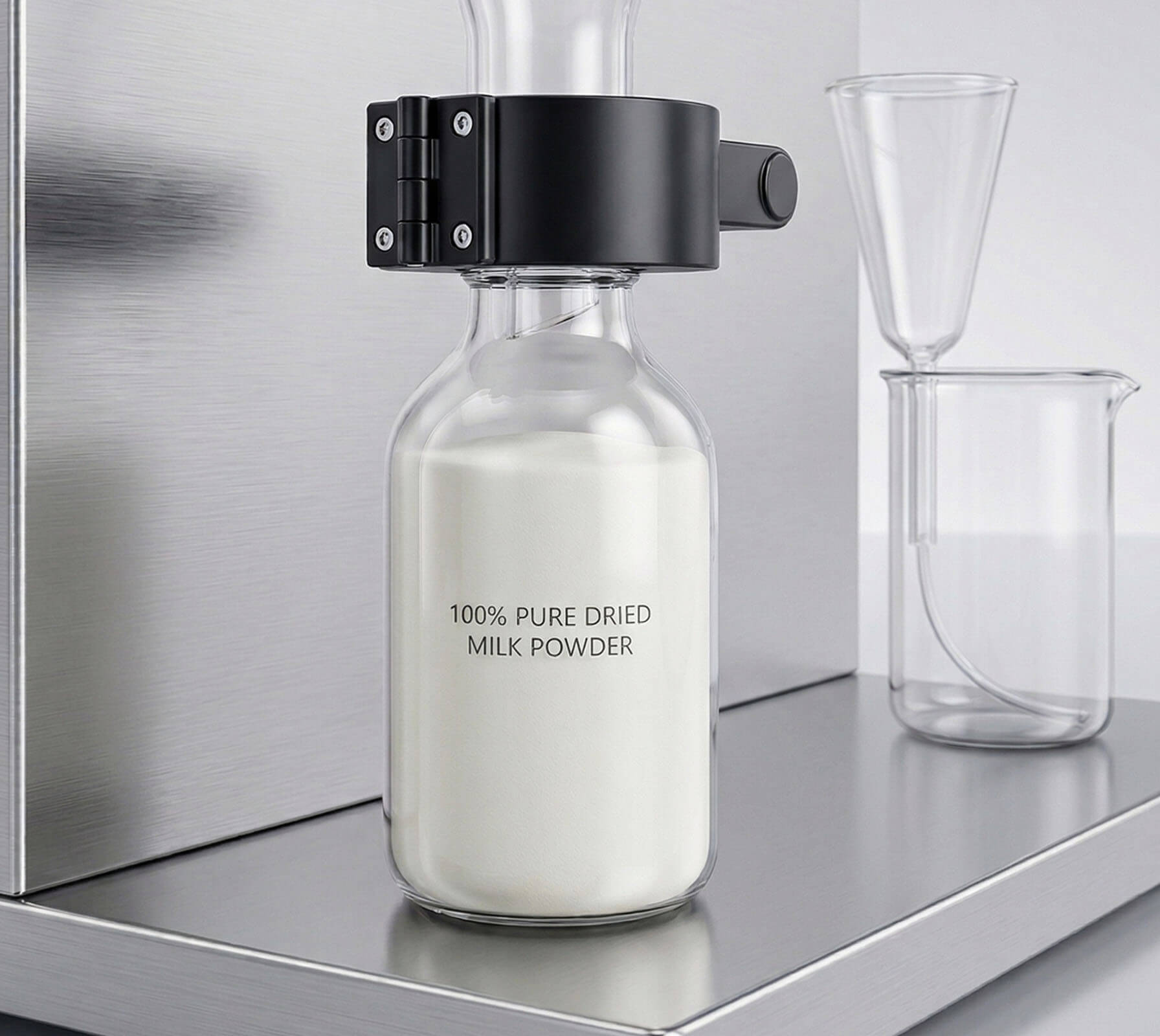
Widely used in industries such as food, pharmaceuticals, and chemicals, it can process various liquid raw materials, including milk and medicinal liquids.

Energy Efficiency And Environmental Friendliness

Incorporating advanced energy recovery techniques minimizes energy waste, aligning with environmental conservation requirements.

User-Friendly Operation

The equipment features an intuitive control interface, facilitating easy operation and monitoring, thereby reducing operational complexity.

Industry Applications & System Configurations

Characteristics

Lanphan spray dryers provide rapid liquid-to-powder conversion for the food, pharmaceutical, chemical, and advanced materials industries. Whether you are processing heat-sensitive extracts, fine chemicals, or bulk dairy ingredients, our systems are tailored to meet your specific particle size and moisture requirements. From lab-scale testing to continuous industrial production, we ensure hygienic processing conditions and precise control over final powder properties.

Backed by over a decade of engineering expertise, Lanphan offers customizable equipment configurations to match your unique feed properties and process goals. For solvent-based or highly sensitive processes, we provide closed-circuit and ATEX-compliant designs to ensure operational safety and environmental control.

Key Features & Process Advantages:

  •   Versatile Atomization: Choose between two-fluid nozzles or centrifugal rotary atomization based on your feed viscosity and target particle size.
  •   Optimized Drying Efficiency: Short residence times protect heat-sensitive active ingredients without degradation.
  •   Integrated Downstream Options: Systems can be configured with internal/external fluid beds, agglomeration modules, and product cooling systems.
  •   Hygienic & Safe Operation: Available with automated CIP (Clean-In-Place) systems and air broom cleaning.
  •   Intelligent Control: User-friendly automated systems ensure repeatable, stable, and continuous output across all production scales.

Request a Quote for Your Spray Dryer Today!

Our spray drying machines are designed to meet the specific needs of your industry. Whether you need a small-scale lab dryer or a large-scale industrial solution, we can help you find the perfect model. Contact us today to receive a customized quote or more information.

Frequently Asked Questions

What is the cost of a spray dryer?

The price of a spray dryer depends on the production scale, configuration, material of construction, atomization system, and optional functions. Lab units, pilot systems, and industrial lines differ significantly in both capacity and specification, so quotation is usually based on the actual process requirement.

How do I choose the right spray dryer for my business?

The right spray dryer depends on your feed material, required evaporation capacity, target particle size, material compatibility, and production scale. For example, lab models are suitable for R&D and small-batch testing, while pilot and industrial systems are better for scale-up and continuous production. If you are unsure which model fits your process, you can provide your material details and output requirements for evaluation.

Can a spray dryer be used for food and pharmaceuticals?

Yes. Spray dryers are widely used in food and pharmaceutical processing when controlled drying conditions, powder consistency, and hygienic design are required. The final system configuration depends on the product characteristics, material contact requirements, and process standards of your application.

Blogs Related to spray dryers