
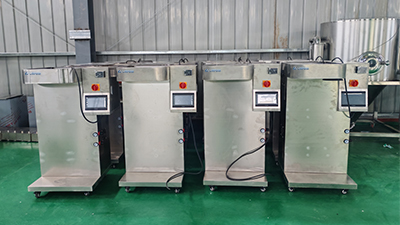
ما هو المجفف بالرذاذ؟
I. What is Spray Drying?
The core principle of spray drying involves atomising a liquid feed (such as a solution, emulsion or suspension) into minute droplets, then bringing these droplets into full contact with hot gas. Through heat and mass transfer, the water within the droplets evaporates rapidly, resulting in a dry powder product.
It is characterised by rapid drying speeds and consistent product quality, and is widely used in various sectors including food, pharmaceuticals and chemicals. It is primarily employed for dehydration, drying and the production of powders, thereby enhancing product stability and facilitating storage and transport.
II. Basic Components and Steps of a Spray Dryer
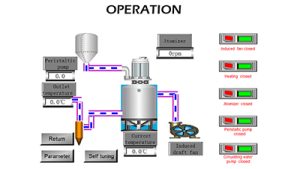
- Feed System: The liquid feedstock is prepared in a feed tank (filtered and adjusted to the required concentration for atomisation) and fed steadily via a peristaltic pump.
- Atomisation System (Core Component): A pressure nozzle and atomiser disperse the liquid into minute droplets (creating a large surface area for contact with hot air, facilitating rapid drying).
- Drying Chamber: The droplets come into contact with the hot air stream within the drying chamber (i.e. the drying process) — involving heat transfer (where the hot air stream transfers heat to the droplets) and mass transfer (where moisture in the droplets evaporates upon heating and enters the hot air stream)
- Hot Air System: Heaters, fans and other components provide a clean, temperature-stable hot air stream for the drying process. Moisture evaporates rapidly, and the droplets are transformed into dry powder in an instant (typically within a few seconds to several tens of seconds)
- Separation and Collection System: Cyclone separators and bag filters are used to separate the dry powder from the exhaust gas. The powder is collected, whilst the exhaust gas is treated before discharge
- Control System: Control of temperature, pressure and feed rate ensures effective atomisation.
III. Key Features of Spray Dryers
Advantages:
- Instantaneous drying with high drying rates (large droplet surface area results in short drying times)
- Consistent product quality (uniform droplet size ensures uniform drying)
- Simple process flow, reducing post-processing steps. (One-step drying and shaping; in most cases, no secondary processing is required)
- Wide range of applications: Suitable for everything from laboratory R&D to large-scale industrial production. (Suitable for various liquid feedstocks: solutions, emulsions, suspensions)
Disadvantages/Limitations:
- High energy consumption (requires heating large volumes of air)
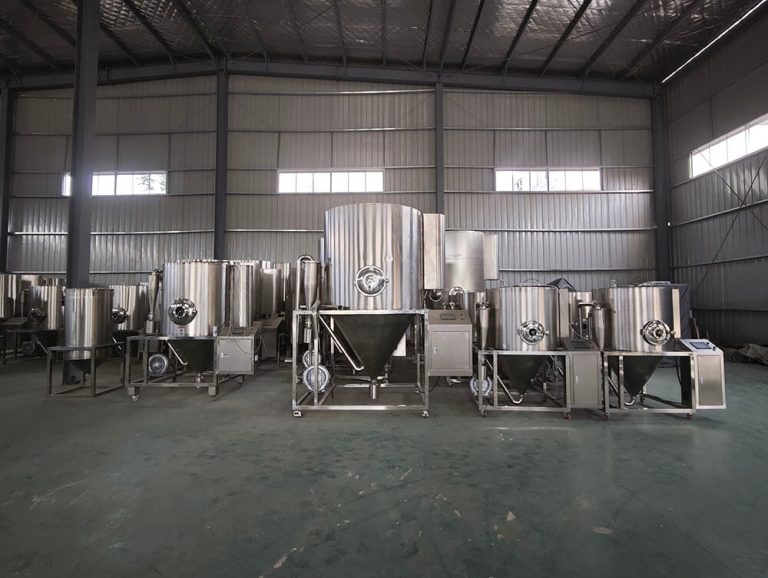
- Bulky equipment (requires significant floor space)
- High requirements for feed quality (impurities may affect spray performance and product quality)
IV. Typical Applications of Spray Dryers
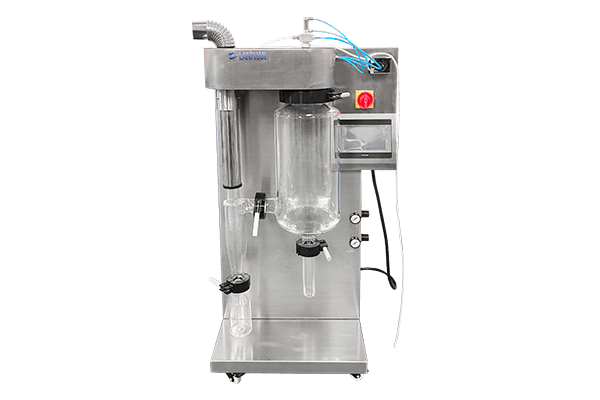
مجففات الرذاذ are widely used in the food, pharmaceutical and chemical industries.
- In the food industry, common applications include milk powder, egg powder, fruit juice powder, coffee powder and food additives
- In the pharmaceutical industry, the primary applications are medicinal powders (such as antibiotics and traditional Chinese medicine extracts) and pharmaceutical excipients
- In the chemical industry, applications include pigment powders, catalyst powders, detergent powders and resin powders
- Other sectors include ceramic materials and cosmetics
V. How to Select the Right Spray Dryer
When selecting a spray dryer suited to your requirements, the first consideration is production capacity. This involves determining the desired hourly output, as well as the time and resources you are willing to invest to achieve this capacity. Next, the decision must be based on the characteristics of the material itself. Different materials may require different drying conditions, such as temperature, humidity and gas pressure. Furthermore, particle size requirements—that is, the desired size of the powder particles—must be taken into account, as this directly affects the quality and yield of the final product. Finally, budget is a key factor, as it will limit the type and functionality of the equipment you can purchase. At the same time, maintenance requirements should not be overlooked, as these will impact the machine’s long-term running costs. By weighing up all these factors, you will be able to find a spray dryer that meets your production needs whilst remaining cost-effective and practical.
 English
  Russian
  Arabic
  Spanish