
What is the difference between freeze dryer and spray dryer?
Introducción
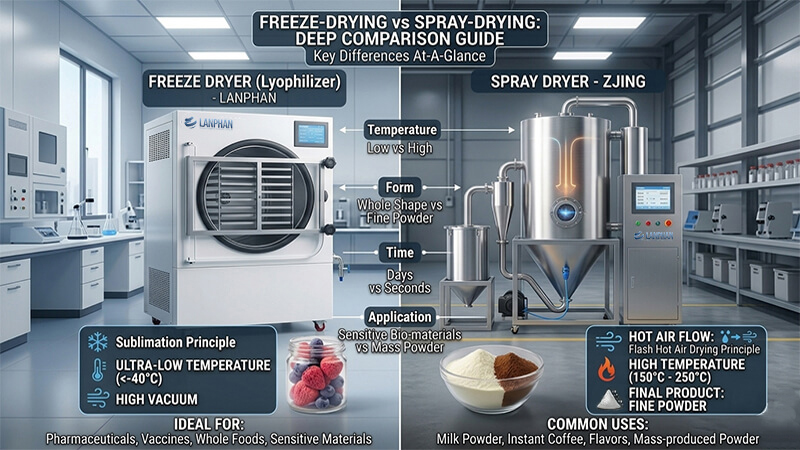
Freeze dryers and spray dryers are both commonly used processing equipment in the food industry. However, there are significant differences between the two. The key distinctions between freeze dryers and spray dryers lie in their drying principles, processing temperatures and the final form of the product. Freeze-drying technology enables the maximum preservation of nutrients and structure; spray drying rapidly converts liquids into powders using hot air. The specific choice depends on the characteristics of the product and production requirements.
¿Qué es un liofilizador?
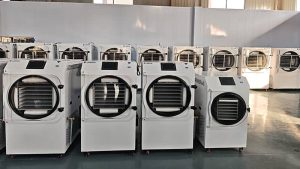
A liofilizador removes moisture from the material through vacuum sublimation. The material is first frozen into a solid state, and then, under vacuum conditions, the ice is directly sublimated into water vapour, thereby maximising the retention of the material’s original structure and activity.
¿Qué es un secador por pulverización?
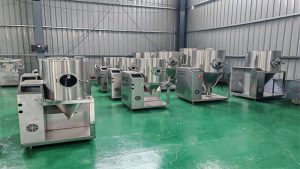
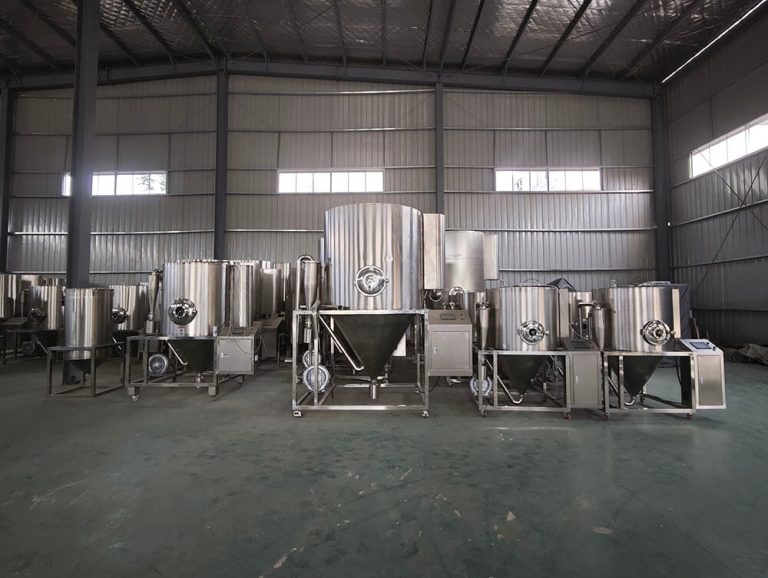
A secador por pulverización rapidly evaporates moisture to form a powder by atomising the liquid and exposing it to hot air; it is suitable for continuous, large-scale production.
Key Differences Between Freeze Dryers and Spray Dryers
| Liofilización | Secado por pulverización | |
| Physical state change | Solid to gas(Sublimation) | Liquid to gas(Vaporization) |
| Operating Temperature | Extremely low (typically below 0°C) | Extremely high (typically above 150°C) |
| Processing Time | Long cycle (24–72 hours) | Extremely fast (within a few seconds) |
| Vacuum Requirements | High vacuum environment | Atmospheric pressure or slight negative pressure |
| Final Form | Loose, porous lumps/powder | Fine Spherical Particles / Fine Powder |
Advantages of Freeze Drying
Freeze drying is suitable for heat-sensitive materials, as it preserves nutrients, flavour and appearance, and is widely used in the pharmaceutical and high-end food sectors. Freeze-dried food retains over 90% of its nutritional content. Furthermore, freeze-dried products such as coffee powder have excellent rehydration properties and dissolve more readily in water. High-quality fruits, in particular, are well-suited to prompt freeze-drying. In laboratories, freeze-drying technology is used for the preservation of microorganisms, pharmaceuticals and various biological products.
Advantages of Spray Drying
Spray drying offers high drying efficiency, low energy consumption and the advantage of continuous production. It is suitable for the production of powders in the dairy, chemical and food industries. It offers good value for money and is suitable for large-scale production. It is suitable for applications where there are requirements for particle fineness and where product quality must be maintained.
Freeze Dryer vs Spray Dryer: Which One Should You Choose?
The choice of equipment ultimately depends on your production requirements and budget. If high-quality products are a priority, freeze-drying is the preferred option, as it ensures that a significant proportion of the product’s nutritional content is retained after processing; however, the costs associated with purchasing and operating a freeze-dryer may be relatively high. If production speed is a key consideration, spray drying is the better choice, as it offers rapid processing, continuous production and relatively lower procurement costs.
Applications of Freeze Dryers and Spray Dryers
Spray dryers: Suitable for a wide range of production scenarios, from small-scale to large-scale operations, and widely used in the dairy, chemical and large-scale food industries.
Freeze dryers: Primarily used for the preparation of small batches of high-end products, with applications in pharmaceuticals, biotechnology and premium food products.
Not sure which drying method to choose?
Get expert advice and a bespoke solution today.
 English
  Russian
  Arabic
  Spanish